She Chose South Carolina Twice — And Dawn Staley Just Landed the Recruit That Could Complete Her Dynasty
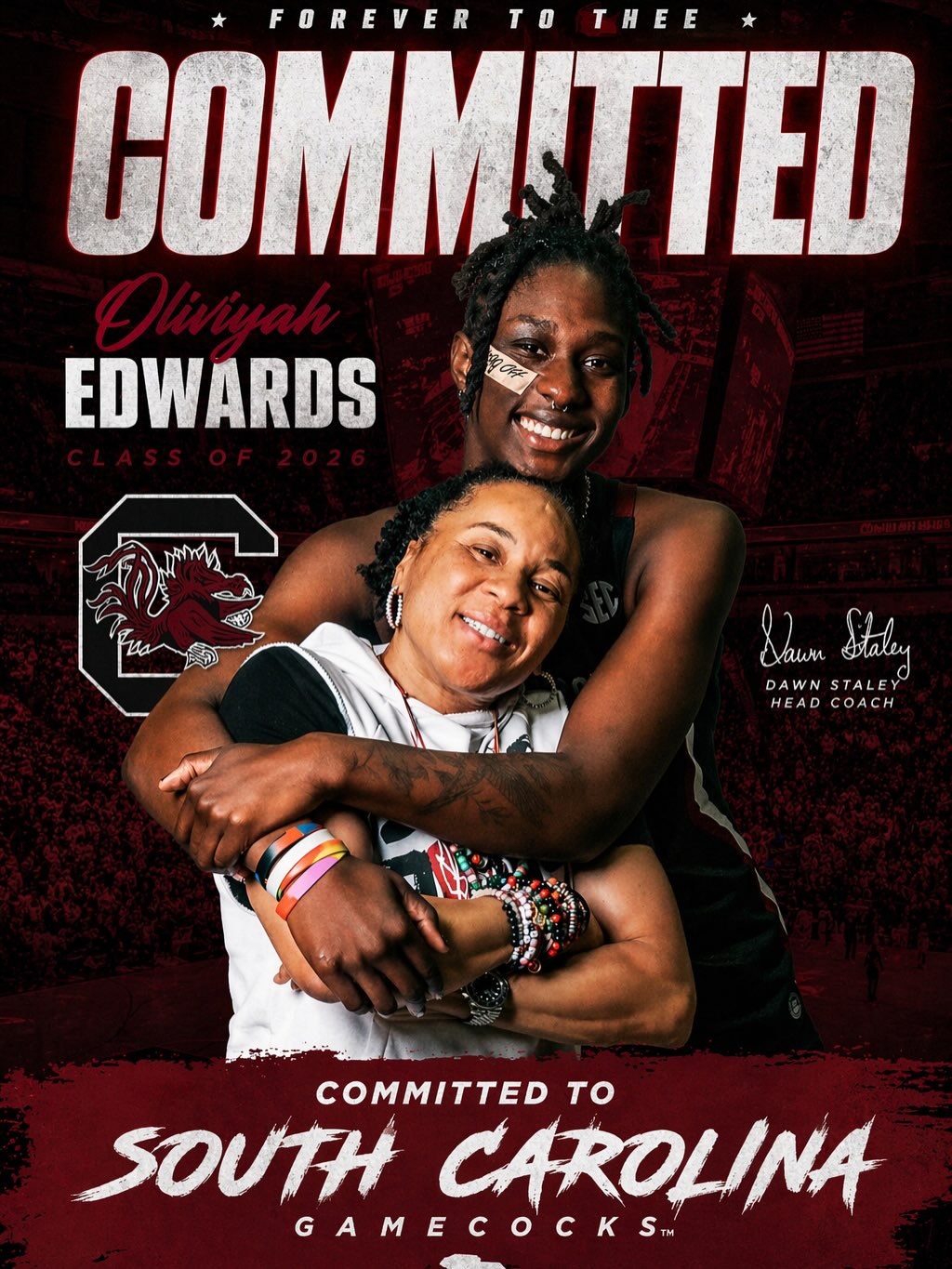
There is a particular kind of validation that comes when a player walks away, reconsiders, and comes back. It says something that a simple commitment cannot. When Oliviyah Edwards posted a video from her visit to Columbia with the caption, “sometimes it takes twice to get it right,” she wasn’t just announcing a decision — she was making a statement about where she believes she belongs.
And where she belongs, as of April 23, is wearing Gamecock colors.
The Recruit: Who Exactly Is Oliviyah Edwards?
Start with the credentials. Edwards is the No. 3 recruit in the Class of 2026, a five-star, 6-foot-3 forward from Tacoma, Washington who plays for Elite Sports Academy — and who can dunk. At a position and level where elite size is common but elite athleticism is rare, Edwards occupies a category that genuinely excites scouts and coaches alike. She was the No. 2 player in her class when Dawn Staley first targeted her, and she’s barely moved — sitting at No. 3 today after the kind of recruitment saga that rarely ends this cleanly for anyone.
Her path to Columbia was anything but straightforward. South Carolina was among her final choices during her original recruitment window before Edwards canceled her scheduled visit in the fall and committed to Tennessee on September 13. She became Tennessee’s highest-ranked signee in seven years — a headline moment for Kim Caldwell’s program and what appeared to be a significant miss for Staley.
Then Tennessee’s offseason imploded.
The Tennessee Collapse That Opened the Door
What happened in Knoxville this spring was extraordinary even by the volatile standards of the modern transfer portal era. All eight of Kim Caldwell’s returners entered the transfer portal following the season. The roster didn’t just thin out — it evaporated. Edwards, who had signed with a program expecting stability and a clear path to contention, was instead released from her commitment on April 7, suddenly one of the most coveted free agents in women’s college basketball.
That is the context that makes this commitment so significant. South Carolina didn’t stumble into Oliviyah Edwards. They had already done the work — built the relationship, made the pitch, earned genuine consideration — before Tennessee ever entered the picture. When the door reopened, Staley walked straight through it.
Edwards visited South Carolina on April 14. She also visited Texas and Louisville this month, and her mother Jordan West told Knox News that in the end, it came down to the Gamecocks and the Lady Vols. The program that had her first, and the program that lost her first. South Carolina won the rematch.
What Edwards Adds to an Already Loaded Roster
The 2026-27 South Carolina roster is now 14 players deep — and the addition of Edwards makes it arguably the most physically imposing and athletically diverse group Dawn Staley has assembled in her 18 years in Columbia.
Consider the frontcourt alone. Edwards joins Kaeli Wynn (6-foot-2) and Kelsi Andrews (6-foot-3) in what is now a three-player freshman forward class with size, skill, and significant upside. Behind them sit Joyce Edwards, Chloe Kitts, Ashlyn Watkins, and Adhel Tac — a returning frontcourt with championship experience, elite rebounding credentials, and a point to prove after back-to-back title game losses.
That is not a rotation. That is an arms race.
Oliviyah Edwards’ ability to dunk is not a novelty — it is a competitive weapon in a sport where true above-the-rim athleticism at the forward position remains genuinely rare. She creates angles that force defensive adjustments, finishes plays that most players her position cannot, and brings a physical ceiling that projects as one of the highest in women’s college basketball for her class.
With Edwards and guard Jerzy Robinson — currently No. 6 in ESPN’s national rankings — Staley now holds two of the top six recruits in the class of 2026 in the same signing class. That kind of concentrated recruiting power is what separates programs that contend from programs that dominate.
The Adidas Wrinkle: A Minor Complication, Not a Dealbreaker
There is one footnote worth addressing. In May 2025, Edwards signed an endorsement deal with Adidas — a partnership that originally aligned perfectly with her Tennessee commitment, given that Adidas is becoming the Lady Vols’ official uniform supplier this summer. South Carolina, meanwhile, is transitioning from Under Armour to Nike.
The resolution is straightforward but not without constraint: Edwards will continue as an Adidas athlete in her personal brand capacity but will not be permitted to wear Adidas clothing or footwear during games as a Gamecock. In the current NIL landscape, where individual branding and institutional affiliation increasingly intersect, this is a manageable arrangement — but it is worth monitoring as the NIL environment continues to evolve. It is unlikely to affect her on-court performance or her standing within the program, but it adds a layer of commercial complexity that is increasingly part of the modern college athlete experience.
Staley’s 2026 Class in Full: The Depth That Wins Championships
With Edwards’ commitment, the full picture of Staley’s 2026 recruiting class comes into focus:
Jerzy Robinson — a 6-foot-1 guard from Sierra Canyon School who chose South Carolina over UConn and LSU, originally ranked No. 5 nationally and now sitting at No. 6. A wing with the athleticism and defensive versatility to contribute immediately.
Kaeli Wynn — a 6-foot-2 forward from Mater Dei High School, now ranked No. 19 nationally, whose only other finalist was Stanford. A skilled, positionless forward who fits Staley’s modern offensive system.
Kelsi Andrews — a 6-foot-3 center from IMG Academy, now ranked No. 30 nationally. Interior depth and length that South Carolina needs behind Kitts and the returning frontcourt pieces.
Oliviyah Edwards — No. 3 nationally. Dunks. Chose South Carolina twice.
This is not a recruiting class. This is a statement.
The Bigger Picture: What This Means for the Dynasty
Two straight national championship losses have a way of motivating elite programs in one of two directions — toward complacency or toward obsession. Everything Staley has done this offseason suggests the latter. She retained her entire returning roster without losing a single player to the transfer portal. She landed the portal’s most complete two-way guard in Jordan Lee — pulled directly from in-conference rival Texas. And now she’s added the No. 3 recruit in the country, a player who initially slipped away and chose to come back.
The 2026-27 South Carolina Gamecocks, on paper, are built differently than any Staley team in recent memory. The depth is real. The size is overwhelming. The returning star power in Joyce Edwards, Kitts, and Watkins is championship-caliber. And a freshman class headlined by two top-six national recruits gives the program a developmental runway that extends well beyond next season.
Oliviyah Edwards chose South Carolina twice. The first time, someone else got in the way. The second time, nothing did.
Dawn Staley’s program just got considerably more dangerous — and the rest of women’s college basketball should be paying attention.
About The Author