From La’Keisha Sutton to Shannon Johnson — Ranking the Greatest South Carolina Gamecocks to Wear Numbers 11 Through 20
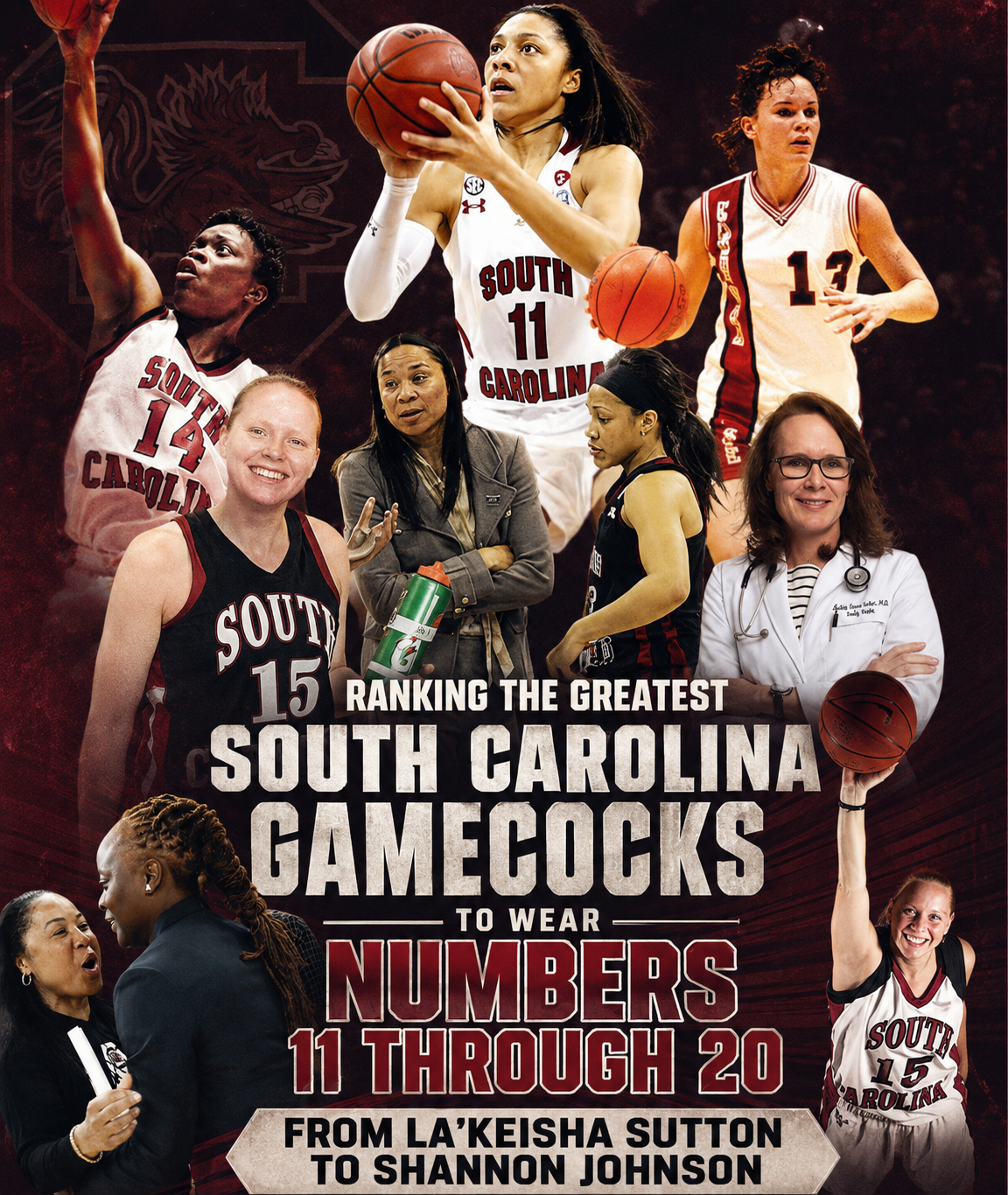
Retired jerseys, Hall of Famers, record-breakers and program legends. The numbers 11 through 20 tell the full story of South Carolina women’s basketball history.
Every great program has its legends. South Carolina women’s basketball has more than most — and the numbers they wore on their backs carry stories worth telling in full. From the first great teams of the Dawn Staley era to the giants of the program’s earliest decades, here is a deep dive into the best Gamecocks to wear jersey numbers 11 through 20.
Note: The numbers 16, 17, 18, and 19 are omitted from this installment — no player in program history has ever worn them.
No. 11 — La’Keisha Sutton (2008-12)
There is a certain poetry in the fact that La’Keisha Sutton wears the No. 11 in South Carolina women’s basketball history, because she was quite literally the first building block of everything that followed.
Sutton was Dawn Staley’s foundational recruit — the first player Staley ever signed at South Carolina — and she delivered on that significance from the very beginning. In Staley’s inaugural season at the helm in 2008-09, Sutton was a unanimous selection to the SEC All-Freshman Team, averaging 11 points and 2.4 assists per game. The program was still finding its footing under its new coach, and Sutton was the player on the floor making that transition work.
Over the next four years, she worked her way into a durable starting role, beginning 91 of the 125 games she played as a Gamecock. Her most complete season came as a senior, when she averaged 10.6 points and 1.3 steals per game — numbers that earned her both an All-SEC Second Team nod and an All-SEC Defensive Team selection. That combination of offensive production and defensive recognition captures exactly the kind of two-way player Sutton was throughout her career.
She finished as the 11th player in program history to record 300 assists while scoring at least 1,000 career points — a statistical milestone that reflects her value as a complete player rather than a one-dimensional contributor. Sutton also played a central role in leading South Carolina to the NCAA Tournament for the first time under Staley in 2012, a moment that signaled the program’s arrival on the national stage.
Her name has resurfaced in national conversation this year as the player development coach for the Philly Rise EYBL program — where top-10 2028 national recruit Giovanna Burress plays — making Sutton’s connection to the South Carolina program as relevant today as it was during her playing days.
Honorable mentions: Madina Okot (2025-26), Lindsey Spann (2017-18)
No. 12 — Brantley Southers (1981-86)
Long before the Colonial Life Arena, the Final Fours, and the national championships, there was Brantley Southers — a Columbia native who quietly became one of the greatest scorers in program history and laid the statistical foundation that players like A’ja Wilson would eventually build upon decades later.
Southers sits fourth on South Carolina’s all-time scoring list with 1,984 career points — a number made all the more remarkable when you understand the era in which she played and the resources that existed for women’s basketball at that time. She averaged 16.5 points per game across her career with the Gamecocks, leading South Carolina in scoring for the final three consecutive seasons of her career. Her senior year production of 20.5 points per game stands as one of the most dominant individual scoring seasons in program history.
The record book treatments go even deeper. Southers is third all-time for career field goals made with 860, sitting behind only A’ja Wilson and Sheila Foster. That she is mentioned in the same statistical breath as A’ja Wilson — widely regarded as the greatest player in WNBA history — tells you everything you need to know about the quality of her career.
During her time with South Carolina, she operated in the Metro Conference era and dominated it completely. Three All-Metro Conference First Team selections, three All-Metro Conference Tournament team honors, the 1986 Metro Conference Player of the Year award, and three All-American honors across her career make her résumé one of the most decorated in the program’s pre-national championship era.
Her induction into the University of South Carolina Athletics Hall of Fame is the permanent institutional recognition of what she accomplished — a player from a different era of the sport who would have been extraordinary in any of them.
Honorable mentions: Charlene Dubose (1974-76), Rita Johnson (1977-81), Brea Beal (2019-23), MiLaysia Fulwiley (2023-25)
No. 13 — Martha Parker (1986-89) 🏆 RETIRED
When a program retires your jersey number and hangs it in the rafters, the conversation about whether you belong on this list is over before it begins.
Martha Parker is one of only a handful of South Carolina women’s basketball players to receive that honor, and the numbers she produced during her three years with the Gamecocks justify every inch of space that banner occupies above Colonial Life Arena.
Parker was a three-time All-American and a two-time Metro Conference Player of the Year — a level of sustained individual excellence that is almost impossible to replicate across a college career. She started 122 of the 124 games she played as a Gamecock, a testament to both her reliability and her irreplaceability in the lineup. During her tenure, South Carolina won three Metro Conference Championships and made three NCAA Tournament appearances — the program’s sustained postseason presence in that era traces directly back to Parker’s impact.
Her final numbers are staggering in their completeness: 1,728 career points, a 13.9-point career scoring average, and 735 career rebounds — figures that place her among the most well-rounded players in the history of the program. She finished as the program’s third-leading scorer, second in career assists, and second in career steals — a production profile across multiple statistical categories that speaks to a player who was genuinely great at all facets of the game.
Parker was inducted into the University of South Carolina Athletics Hall of Fame in 1995. She was also recently recognized as an honorable mention for the program’s Mount Rushmore — which means she narrowly missed the top four of one of the deepest collections of talent any women’s basketball program has ever assembled. That near-miss is not a slight. It is simply evidence of how extraordinary this program’s legacy has become.
Honorable mention: Sharon Rivers (1979-83)
No. 14 — Shannon Johnson (1993-96) 🏆 RETIRED
If Brantley Southers and Martha Parker defined what greatness looked like in the Metro Conference era, Shannon Johnson is the player who proved South Carolina could produce a legitimate national superstar.
The No. 14 is retired. It hangs in the Colonial Life Arena rafters alongside Parker’s No. 13, and the case for that honor rests on one of the most prolific individual careers in the history of college women’s basketball.
Johnson is second in program history with a career scoring average of 20.5 points per game. More astonishingly, she is the only player in South Carolina women’s basketball history to average 20-plus points per game for three consecutive seasons — a feat that no player before or since has come close to matching. When her career concluded, her 2,230 career points were the most in program history, a record that stood until A’ja Wilson — who many consider the greatest player in WNBA history — eventually eclipsed it.
The hardware matched the production. Three All-SEC First Team selections across three years of play. A 1996 All-American designation. A finalist for both the Naismith Trophy and the Wade Trophy in the same season — the two most prestigious individual awards in women’s college basketball. Each of those honors on its own would define a career. Johnson collected them together in a single remarkable season.
The Hartsville native was inducted into the University of South Carolina Athletics Hall of Fame in 2004, joining Parker as one of the program’s most permanently celebrated figures. Her legacy is not just statistical — she helped elevate the standard of what South Carolina women’s basketball could look like at its absolute best, laying a blueprint that Dawn Staley would eventually use to build a dynasty.
Honorable mentions: Marsi McAlister (1981-85), Iva Sliskovic (2004-07)
No. 15 — Cristina Ciocan (2000-04)
Not every era of South Carolina women’s basketball produced the kind of marquee stars that define the program’s highest peaks. The early 2000s was a transitional period for the Gamecocks — but within that context, Cristina Ciocan was the most complete and impactful player to wear any number in this range.
The Romanian guard played 116 games for South Carolina and left a statistical fingerprint on the program’s record book that endures more than two decades later. Her career averages of 8.7 points and 5.3 assists per game tell the story of a facilitator-first player — a pass-first guard who made everyone around her better rather than prioritizing her own offensive production.
Her junior season was her finest individual year, when she averaged a career-high 13.6 points, 6.7 assists, and 2.4 steals per game — a performance that earned her All-SEC Third Team honors and announced her as one of the more complete guards in the conference. That year also produced one of the most memorable individual performances in program history, when she recorded 22 points, 10 rebounds, and 13 assists against Clemson in 2003 — one of only nine triple-doubles in program history.
Ciocan was also part of the program’s first Elite Eight run in 2002, a milestone moment that began building the postseason credibility that Staley would eventually transform into a championship program.
Her lasting statistical legacy is in the assist columns. Ciocan is second on South Carolina’s all-time career assist leaderboard with 615, and she holds both the program record for assists in a single game (18) and the program record for career assists average (5.3). Those records have stood for more than 20 years — an extraordinary testament to her impact as a facilitator at a program that now routinely recruits McDonald’s All-Americans.
Honorable mention: Laeticia Amihere (2019-23)
No. 20 — Karen Middleton (1988-91)
The race for the best to wear No. 20 is one of the more interesting debates in this entire series — a direct comparison between Karen Middleton and Christi Timmons, two of the greatest three-point shooters in program history who happen to be separated by just a few years in their tenures at South Carolina.
Middleton gets the nod, and the numbers explain why. She scored 1,714 points in four years with the Gamecocks, averaging at least 10 points per game throughout her career and finishing with a career mark of 13.4 points per game. A Freshman All-American in 1988 and a two-time All-Metro Conference selection, Middleton was a consistent, high-level performer throughout her career.
But her true legacy lives in one specific statistical category. Middleton holds the South Carolina program record for career three-point field goals made with 317, and she also holds the program record for career three-point field goal percentage at 44.5%. Those two records — volume and efficiency together — represent the most complete three-point shooting career in the history of the program. The fact that Timmons is right behind her in both categories only underscores how dominant that era of Gamecock shooting was.
The McBee native’s impact on how South Carolina could be played offensively during the transition into the three-point era was significant. She proved that the Gamecocks could deploy elite perimeter shooting at a time when the program was still establishing its identity.
One notable honorable mention: Sania Feagin (2022-25) — a name that has been part of recent discussions around South Carolina’s frontcourt depth and a player whose development trajectory at the professional level remains a topic of significant interest in women’s basketball circles.
Honorable mentions: Christi Timmons (1991-95), Sania Feagin (2022-25)
The Big Picture
What the numbers 11 through 20 collectively represent in South Carolina women’s basketball history is the full arc of a program’s growth — from foundational building-block players like Sutton to pre-dynasty dominators like Southers and Parker to generational talents like Shannon Johnson whose production has never been fully replicated.
Two retired jerseys. Three Hall of Famers. Multiple all-time program records. The history embedded in these numbers is a reminder that before the Final Fours and the national championships, there were players who built this program one game, one season, and one extraordinary career at a time. 🐔
About The Author