
Isabelle Fijalkowski Opens Up on Guiding Daughter Alicia Tournebize’s NCAA Journey to South Carolina
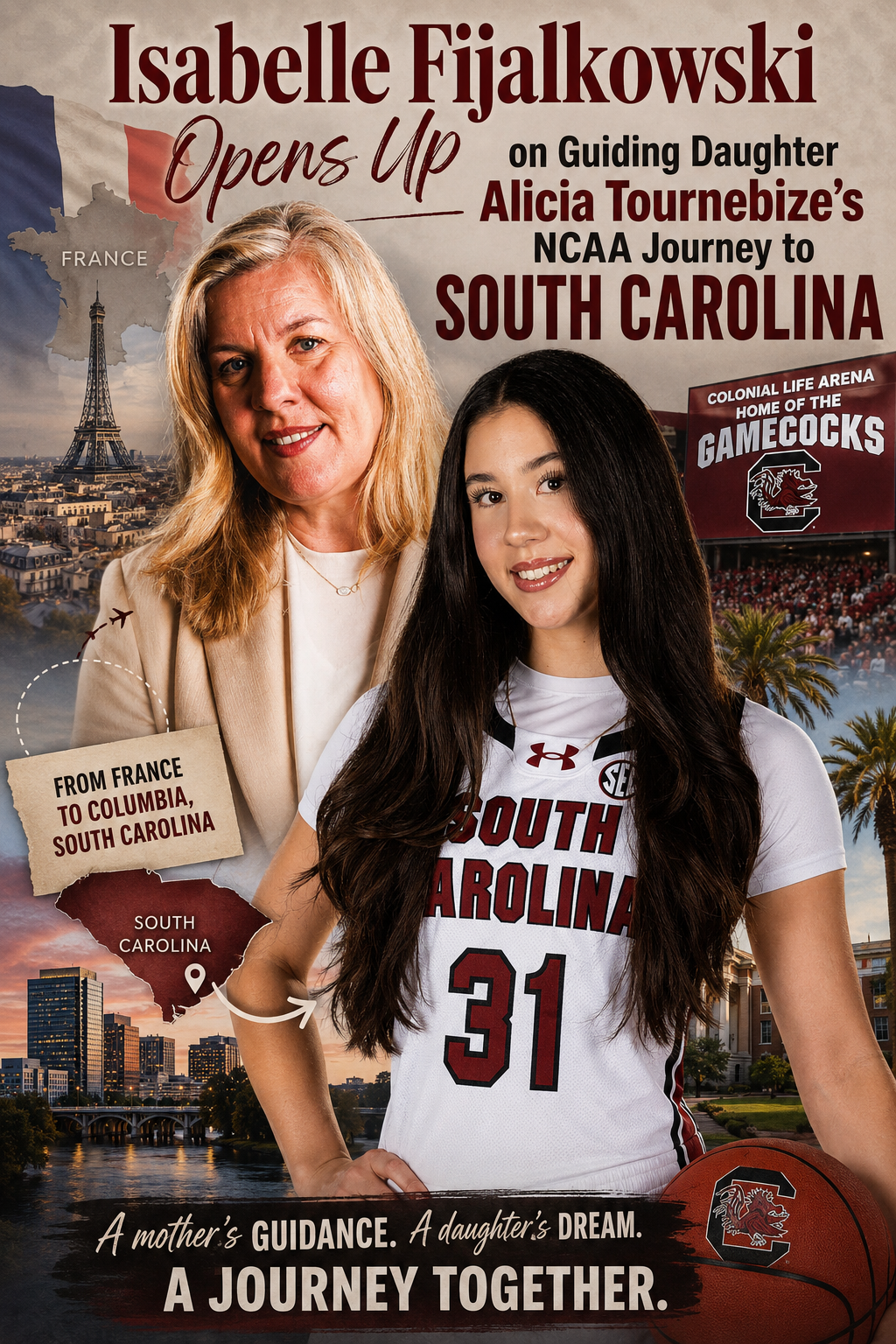
When Alicia Tournebize made the decision to leave Bourges and head to South Carolina at the start of the year, it wasn’t just another international transfer story — it was a move shaped by family basketball pedigree. Her mother, Isabelle Fijalkowski, a former standout who lived through her own American basketball experience, has been instrumental in steering the transition, and she recently opened up about the role she’s played behind the scenes.
A Mother’s Role, Backed by Personal Experience
Asked directly about her involvement in Alicia’s decision to leave France for NCAA basketball, Fijalkowski was clear that her primary identity in this process is maternal, even if her background gives her unique insight most parents don’t have.
“Well, yes, it’s mostly my role as a mom,” she explained. “Indeed, thanks to my American experience, I had the contacts and was able to guide Alicia’s choices a little. But for me, in my role as a mom and as a companion, it’s about accompanying her and making sure she finds herself in the environment that suits her best.”
That framing matters: Fijalkowski isn’t positioning herself as an agent or handler, but as a guide drawing on lived experience to help her daughter land somewhere she can actually thrive — not just somewhere with name recognition.
Why Leaving Early Made Sense
Tournebize’s departure came earlier than originally planned, a detail Fijalkowski addressed directly by connecting it to a core basketball principle — playing time matters more than the prestige of a roster spot.
“Indeed, there was this opportunity for Alicia to leave earlier than planned. She is a young player, and what’s important is to play,” she said.
To illustrate the point, Fijalkowski turned to her own career, recalling her experience breaking into top-flight competition as a teenager. “My own experience is quite telling because at 16 years old, I had 20 minutes in the first division,” she said. “They were making me play, and I was learning fast because I was training a lot with the seniors and playing on weekends.”
The Case Against Sitting on the Bench
Perhaps the most pointed part of Fijalkowski’s comments addressed a broader philosophy about player development — one that clearly informed the decision to send Alicia to the NCAA rather than keep her in a more passive role within a professional system.

“It’s not enough to train with the pros — whether it’s good or not, whether it’s full-time or not — and just sit on the bench. At some point, you have to go through the trial by fire,” she said.
That belief, more than anything, appears to be the foundation of the South Carolina move. Fijalkowski described the NCAA environment as uniquely suited to what her daughter needs at this stage of her career.
Why South Carolina and the NCAA Fit Alicia’s Development
Breaking down the specifics, Fijalkowski explained how the structure of college basketball — both in terms of competition level and training regimen — aligns with what a young player like Alicia requires to grow.
“The NCAA championship matches Alicia’s needs, meaning playing time — actually playing in a league with players her age or up to three years older, in conditions where she went for two months. She will develop, she will train physically and technically. There are important training blocks and game blocks where you put into practice what you’ve worked on,” she said.
This is a key analytical point: rather than viewing the NCAA as simply a stepping stone or a brand-name destination, Fijalkowski frames it as a structured developmental pipeline — one that blends physical conditioning, technical training, and meaningful in-game minutes against age-appropriate or slightly older competition.
Leveraging Experience and Relationships
Finally, Fijalkowski credited her own standing in American basketball circles for making the transition smoother than it might otherwise have been for a young French prospect crossing the Atlantic.
“I accompany her and advise her because I know how things work over there, and people know me too. That’s what has allowed this transition to go so well,” she said. “In addition, I wish for her to have the opportunities to develop.”
Taken together, Fijalkowski’s comments paint a picture of a calculated, experience-informed decision rather than an impulsive jump. Her own history navigating American basketball gave the family a roadmap, and her insistence on early playing time over bench-sitting suggests the move to South Carolina was less about prestige and more about accelerating Alicia’s development through real competitive minutes — the same trial-by-fire approach that shaped Fijalkowski’s own career decades earlier.
About The Author