New Evidence and Details Surface in Arrest of USC Football Player — Police Records Tell a Different Story.
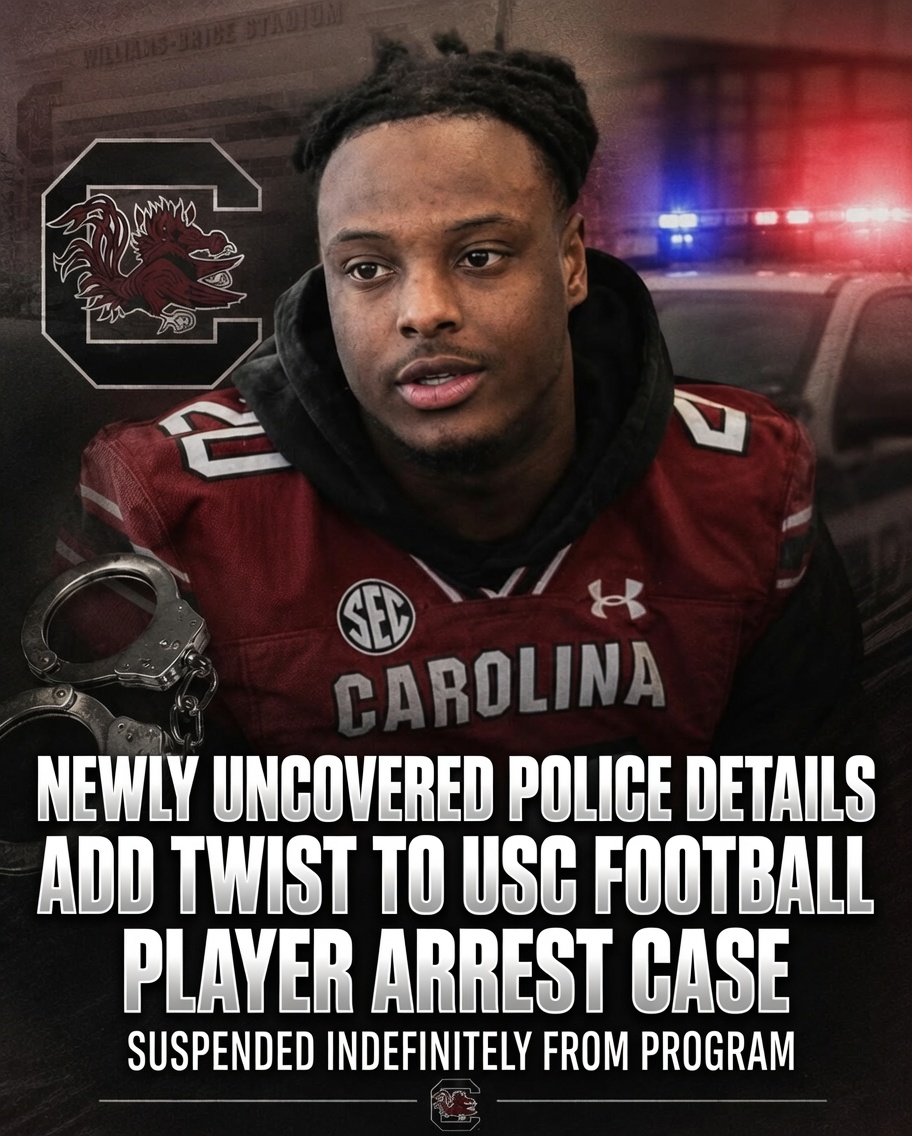
A Transfer Running Back, A String of Campus Break-Ins, and A Football Career That May Be Over at 21
Sam Williams-Dixon arrived in Columbia in January with three years of eligibility, a transfer from one of college football’s most prestigious programs, and what appeared to be a second chance at carving out a meaningful college career.
Six months later, he is dismissed from the team, facing seven criminal charges, and out on a $150,000 bond after police say he and his younger brother broke into three vehicles near the South Carolina campus over the span of five days.
The fall was swift. The evidence, according to arrest warrants, was overwhelming.
What the Warrants Actually Say
The University of South Carolina Police Department obtained arrest warrants for both Sam Williams-Dixon, 21, and his younger brother Elijah Williams-Dixon, 19, after an investigation that produced video surveillance footage, access card records, a confession, and property recovered directly from the Williams-Dixon residence. That is not a circumstantial case. That is the kind of evidentiary foundation that typically leaves very little room for alternative narratives.
The timeline spanned June 7 through June 12 and involved three separate vehicles at two different student apartment complexes near campus.
The first incident, on June 7 or 8, targeted a 2023 Dodge Charger parked at 650 Lincoln Street — the address for an on-campus USC student housing complex. The stolen items were specific and high-value: a pair of Rick Owens shoes valued at $1,400, a Gucci watch worth $2,000, a Cuban link chain with a “B” pendant valued at $6,000, $300 cash, a key fob cover, and a pair of Jordan brand sneakers. The total haul from that single vehicle exceeded $9,000.
The second incident, on June 10 or 11, targeted another vehicle at the same 650 Lincoln Street location — a 2018 Dodge Charger — with specific stolen items unlisted in the warrant but the intent to steal documented.
The third incident, on June 12, moved to 737 Gadsden Street — the address for Gateway 737, another nearby student apartment complex — where the brothers allegedly broke into a 2026 Mercedes SUV.
Three vehicles. Five days. Two adjacent student housing complexes. The pattern suggests this was not impulsive — it was repeated behavior in familiar locations.
The Institutional Response and Its Timeline
South Carolina’s handling of the situation followed a now-familiar escalation sequence that is worth examining critically.
When The State first inquired Sunday, a program spokesman confirmed Williams-Dixon had been suspended “indefinitely.” By Monday night — after the public records request produced copies of the arrest warrants — that suspension became a full dismissal. The university did not get ahead of this story. They responded to it.
That distinction matters, not because it changes the legal outcome for Williams-Dixon, but because it reflects the degree to which programs are often reactive rather than proactive when criminal matters involve their players. The arrest happened Saturday. The dismissal came Monday. The interim period was “indefinite suspension” — language that preserves optionality while the institution assesses the situation’s severity and public trajectory.
Given the nature and volume of evidence outlined in the warrants — surveillance footage, access card records, a confession, and recovered property — the dismissal was ultimately the only defensible outcome. But the 48-hour window between “indefinitely suspended” and “dismissed” reveals the institutional calculus that happens behind closed doors before programs make final decisions on roster matters.
Who Sam Williams-Dixon Was Before This
The biographical context matters, not as mitigation, but as a fuller picture of what was lost — and what this decision reveals about the choices involved.
Williams-Dixon transferred to South Carolina from Ohio State in January, one of three transfer running backs the Gamecocks signed for 2026. He was listed as a redshirt sophomore with three full years of eligibility remaining — a rare commodity in the portal era, where most transfers arrive with one or two years left. At Ohio State, he logged 10 carries for 62 yards and a touchdown across two seasons, limited production that was almost certainly a function of depth chart constraints rather than capability. He had legitimate upside as a player who had survived the roster culture of one of college football’s most demanding programs.
He was 21 years old. A sports media major. Three years of eligibility. A fresh start at a program that wanted him.
The items allegedly stolen from these vehicles were consumer goods — expensive ones, but consumer goods nonetheless. The legal exposure he now carries — seven charges including grand larceny and criminal conspiracy, paired with a $150,000 bond — will follow him regardless of how the criminal case ultimately resolves. His football career at South Carolina is finished. Whether any program in the country offers him another opportunity will depend heavily on how the legal process unfolds.
The Brother Dimension
Elijah Williams-Dixon, 19, is not a South Carolina student, not on the football roster, and has no listed affiliation with the university beyond being Sam’s younger brother. His presence in Columbia and his alleged involvement across all three incidents raises questions that the arrest warrants don’t fully answer — how long he had been in Columbia, what his living situation was, and what the nature of the brothers’ arrangement looked like during this period.
What the warrants do confirm is that both men face identical charges: three counts of larceny/breaking into a motor vehicle, three counts of criminal conspiracy, and one count of grand larceny. Both posted $150,000 personal recognizance bonds and were released from the Alvin S. Glenn Detention Center on Sunday.
The Larger Picture
College football’s transfer portal has created genuine opportunity for players to find the right fit, rebuild careers, and maximize their eligibility in environments where they can thrive. Sam Williams-Dixon was a product of that system — a player who left Ohio State for a fresh start and arrived in Columbia with everything ahead of him.
What the portal cannot manufacture is judgment. And the evidence assembled by the University of South Carolina Police Department suggests that whatever drove these decisions — financial pressure, poor influence, impulsivity, or something else entirely — it overrode every professional and personal incentive Williams-Dixon had to protect the opportunity he’d just been handed.
Three years of eligibility. A Division I roster spot. A program that signed him and ran him through a full spring practice.
Gone in five days.
About The Author