She Left France’s Professional League To Chase A WNBA DreamIn Columbia — And Dawn Staley Just Promised To Deliver It

There is a specific kind of courage required to leave everything familiar — your language, your country, your professional league — and step into one of the most demanding environments in women’s college basketball. Justine Loubens made that choice, and the conviction behind it was not built on blind faith. It was built on a clear-eyed assessment of what Dawn Staley’s program can do for a player with the right tools, the right mindset, and a WNBA dream she is not willing to leave to chance.
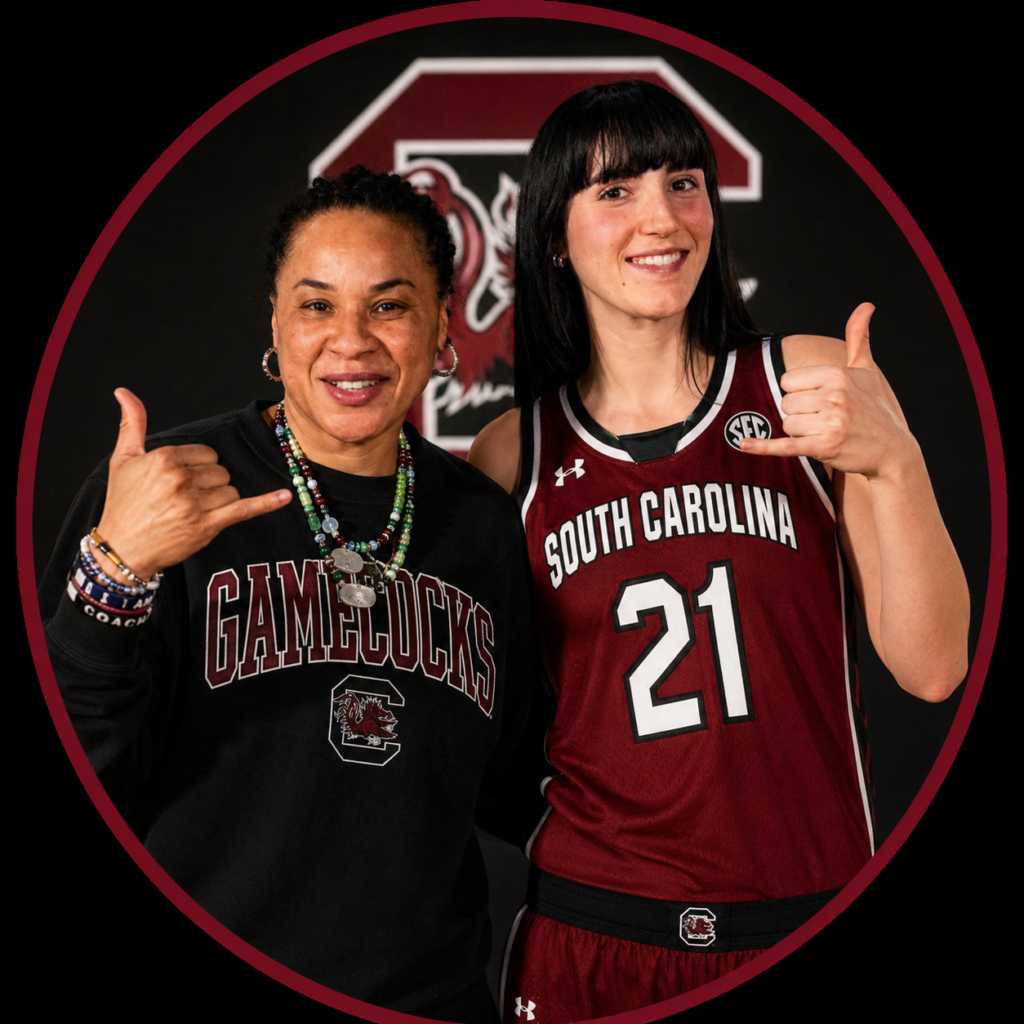
South Carolina officially announced Loubens’ signing on Tuesday, confirming the 6-foot-1 French wing will join the Gamecocks with four years of eligibility beginning with the 2026-27 academic year. She arrives not as a raw developmental project, but as a player who has already competed at two levels of professional basketball in France — and whose statistical record in those environments suggests she is considerably further along than her age would typically indicate.
What Staley Saw — And Why She Went To France To Find It
Dawn Staley’s recruiting philosophy has always prioritized specific, complementary skill sets over name recognition alone, and her assessment of Loubens reflected that precision.
“We’re excited to bring Justine into our Gamecock family,” Staley said. “She is one of the best shooters coming out of France, and her experience playing for her club and national teams have helped prepare her for the SEC battles to come.”
The phrase “one of the best shooters coming out of France” is not generic praise. It is a specific, positional endorsement from a coach who understands exactly what her roster needs and exactly what Loubens brings to fill it. South Carolina’s frontcourt is anchored by physically dominant post presences in Joyce Edwards and Chloe Kitts. The offensive system that maximizes those players requires perimeter shooters who can space the floor intelligently, punish defensive collapses, and operate within structure without demanding the ball to be effective. Loubens’ shooting profile — built across multiple years of professional competition — fits that requirement with a precision that is difficult to manufacture through development alone.
The Professional Résumé That Sets Her Apart
What separates Loubens from a typical international freshman recruit is not her potential. It is her experience. She has already played two seasons of professional basketball in France before setting foot on a college campus — a developmental timeline that most incoming college freshmen, regardless of high school profile, simply cannot match.
Most recently, Loubens competed in France’s premier women’s professional league — the Ligue Féminine de Basketball — with La Roche Vendée, averaging 6.5 points and 2.5 rebounds while shooting a remarkable 63.9 percent from the field across 24 games. The efficiency number is the headline. Shooting 63.9 percent in a professional league is not the product of shot hunting or limited usage — it reflects a player who understands shot selection, moves intelligently without the ball, and converts the opportunities she earns.
The season prior, she played 22 games for Centre Fédéral BB Paris in France’s second-tier league, averaging 7.9 points, 2.3 rebounds, and 1.5 steals per game. The steals number is particularly interesting — it signals defensive activity and court awareness that goes beyond a shooter’s profile, suggesting Loubens’ value to South Carolina extends to both ends of the floor.
The International Stage — A Track Record That Speaks
Loubens’ national team history with France provides additional layers of context for evaluating where she is as a basketball player and how quickly she might contribute in the SEC.
Her most dominant individual international performance came at the 2024 FIBA U17 World Cup, where she was France’s leading scorer — averaging 11.3 points and shooting 52.0 percent from three-point range. That shooting percentage from beyond the arc, sustained over a full international competition against the world’s best players in her age group, is the kind of number that justifies Staley’s “one of the best shooters” characterization unambiguously.
In the 2025 FIBA U18 Eurobasket event, she averaged 7.6 points and 2.7 rebounds on 49.0 percent shooting as France claimed a third-place bronze medal finish. And her international debut — the 2023 FIBA U16 European Championships — ended in a gold medal, with Loubens contributing 6.8 points and 3.5 rebounds per game on a championship-winning squad.
Three international competitions. Three years of ascending performance. A gold medal, a bronze medal, and a leading scorer designation in between. The trajectory is not simply encouraging — it is conclusive.
The WNBA Declaration — And Why It Matters
Perhaps the most striking element of Loubens’ arrival in Columbia is the directness with which she has articulated her professional ambitions — and the specific reason she believes South Carolina is where those ambitions get realized.
“It is exciting to be a part of a new system, the Dawn Staley system,” Loubens said. “I see myself in the space of 4 years becoming a WNBA player because Dawn Staley will bring out the best in me and help me to connect the missing parts as I improve myself with the Gamecocks. So I am very happy to be part of the program that is home to all no matter the color or language. I love it here. I love the fans, they are exceptional with their support and love for the Gamecocks WBB. I always wanted to be a part of something bigger so the Gamecocks is bigger. It’s just where my heart is.”
The specificity of that statement deserves careful attention. Loubens is not expressing a general hope that professional basketball might someday be possible. She is drawing a direct causal line between Staley’s coaching, her own development, and a WNBA outcome — naming the coach and the program as the mechanism through which the missing pieces in her game will be assembled.
That is a remarkable level of conviction for a player stepping into a new country, a new language, and a new system. It is also the kind of conviction that produces the daily competitive commitment necessary to actually realize that kind of goal. Players who arrive with vague aspirations tend to develop vaguely. Players who arrive with specific, articulated goals tied to specific developmental beliefs tend to develop with purpose.
Loubens is clearly the latter.
The Tournebize Connection — More Than A Recruiting Angle
The prior relationship between Loubens and current South Carolina freshman Alicia Tournebize — teammates on the French National Team in both 2024 and 2025 — provides a bridge into the program that most international recruits never have access to. Tournebize made the same cross-cultural transition to Columbia that Loubens is now undertaking, and her presence on the roster gives Loubens a built-in guide through every dimension of the adjustment that no coach or academic advisor can fully provide.
Loubens was direct about how significant that connection was in her decision.
“It’s great, I am happy we have represented our country back home and we are both exploring new grounds to improve our skills, become the best,” Loubens said. “It’s just great. I just knew that I had to follow her lead to be with this program.”
The phrase “follow her lead” is analytically revealing. Tournebize’s successful transition to South Carolina — the comfort she has found in the program, the relationships she has built, the way she has navigated the cultural and linguistic dimensions of playing college basketball in the American South — served as a real-time proof of concept for Loubens. She did not simply take a coach’s word that South Carolina was the right environment for a French player. She watched someone she knew, trusted, and had competed alongside do it successfully first.
That kind of peer validation is among the most powerful recruiting tools that exist — and South Carolina did not engineer it artificially. It emerged organically from the program’s genuine commitment to building an inclusive, global environment that Loubens herself described as “home to all no matter the color or language.”
What Four Years Of Loubens Means For South Carolina
With four full years of eligibility ahead of her, Loubens represents one of the most intriguing long-term developmental investments in South Carolina’s 2026 recruiting class. The foundation she brings — professional experience, elite shooting efficiency, international competition credentials, and a defined WNBA aspiration — is not a project that needs to be built from scratch. It is a skill set that needs to be refined, contextualized within Staley’s system, and given the time and repetitions to operate at the SEC level with confidence.
If the development arc follows its current trajectory, by her junior and senior seasons Loubens could be among the most difficult players in the country to defend in South Carolina’s offensive system — a professional-grade shooter operating within a championship infrastructure, surrounded by elite talent, and coached by the best women’s basketball mind in the country.
She left France’s professional league to chase something bigger. Based on everything she has already demonstrated, the only reasonable question is not whether she reaches the WNBA.
It is how high she goes when she gets there.
About The Author