She Won a Gold Medal Monday, Moved Into Her Dorm Tuesday — South Carolina’s Most Intriguing Freshman Just Arrived
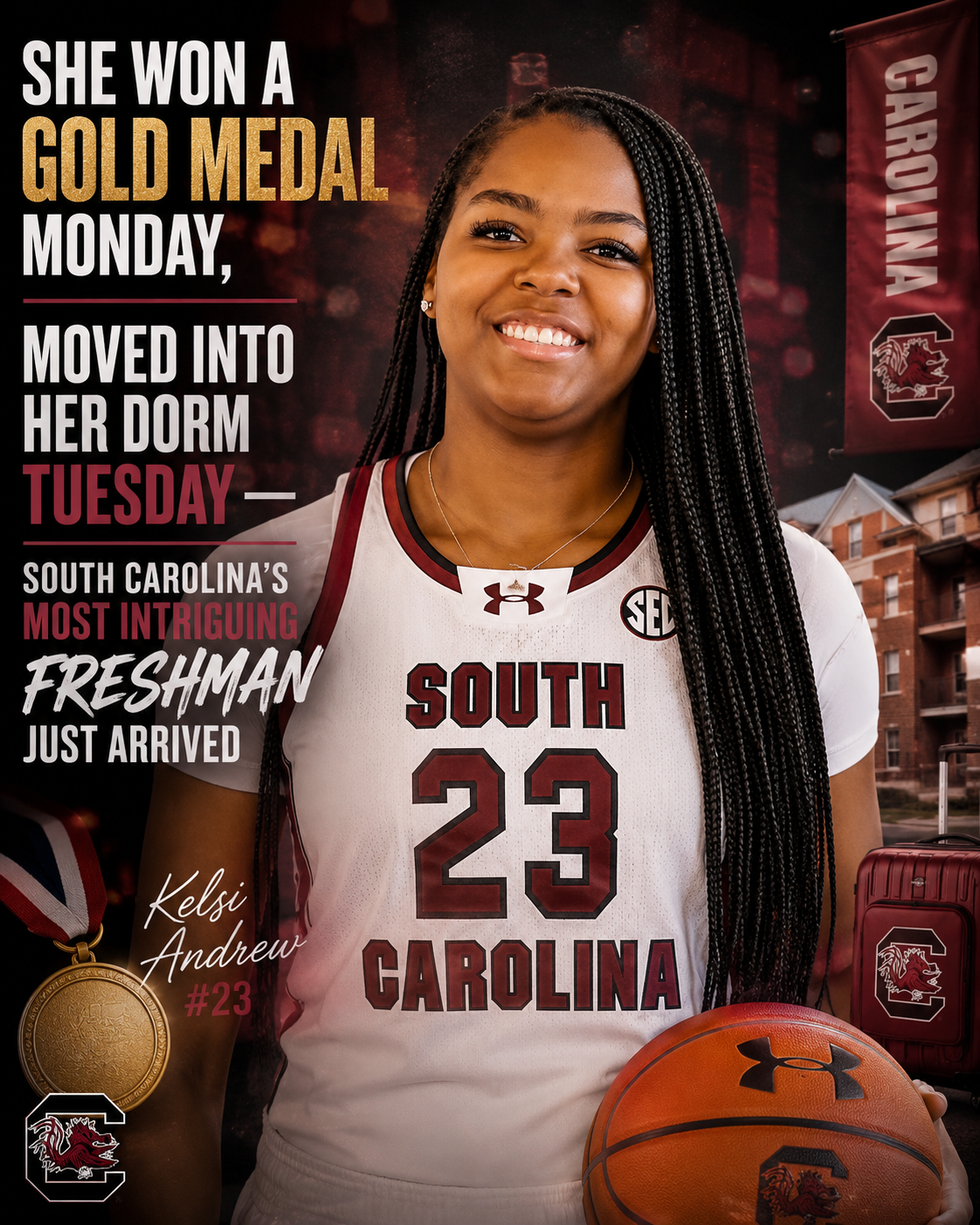
There is no offseason when you are Kelsi Andrews.
One day after helping the United States claim gold at the FIBA U18 Women’s AmeriCup in Irapuato, Mexico — her third international gold medal before her first college practice — Andrews moved into South Carolina’s campus on June 16, officially beginning what may become one of the more closely watched freshman careers in women’s college basketball.
The turnaround between continental championship and move-in day is almost absurdly compressed. But it is also, perhaps, the most revealing possible introduction to who Andrews is as a competitor. There was no victory lap. No extended celebration. She won on Monday and reported to Columbia on Tuesday.
Dawn Staley is already getting exactly what she recruited.
The Recruiting Battle That Ended in Columbia
To appreciate what South Carolina secured, start with the competition they beat to get her.
Ohio State. Duke. North Carolina. LSU. Notre Dame. Andrews drew interest from programs that collectively represent some of the most resourced, most visible, and most successful operations in women’s college basketball. She was the first Class of 2026 recruit to commit to Staley, announcing after an official visit the weekend of September 26 before signing on November 12.
That early commitment — before the recruiting process fully matured, before she could have explored every option — reflects a specific kind of conviction. Andrews didn’t need to see everything the market had to offer. She identified South Carolina as the right destination and committed to it. For a program that builds its identity on players who choose the standard rather than stumble into it, that decision-making process matters.
Andrews was initially ranked as the highest-rated four-star prospect in ESPN’s Class of 2026 before suffering a torn meniscus in October — an injury that nudged her to No. 30 in espnW’s top 100. The ranking adjustment is understandable from a scouting methodology standpoint. The injury, however, does not alter the underlying talent profile that generated the original evaluation. It only adds a recovery variable to a player whose ceiling was already being discussed in significant terms.
The Jokić Comparison and What It Actually Means
The most striking endorsement in Andrews’ recruiting profile came from her IMG Academy head coach, Frank Oliver Jr., who compared her versatility to three-time NBA MVP Nikola Jokić.
That comparison requires careful handling. Applied carelessly, it becomes hyperbole. Understood in its proper context, it is analytically precise and worth unpacking.
Jokić’s defining characteristic is not any single skill — it is the combination of skills that has no natural defensive answer. A center who can shoot from distance, pass at a guard’s level, and process the game at an elite cognitive speed forces defenses into impossible choices. Doubling him abandons shooters. Dropping invites the jumper. Switching creates mismatches everywhere.
Oliver is describing the same structural problem Andrews creates. At 6-foot-4, she can shoot from NBA range, pass to create for teammates, and defend across multiple positions. South Carolina’s offense under Staley has historically been most dangerous when its frontcourt players can operate outside the paint as well as inside it — think A’ja Wilson’s face-up game, think Aliyah Boston’s passing and positioning. Andrews appears built for exactly that kind of multidimensional frontcourt role.
Staley’s own assessment reinforced the versatility argument:
“Kelsi brings a unique combination of size, skill and versatility that perfectly fit how we want to play. Her basketball IQ, defensive presence and resilience make her a special addition to our Gamecock family. And, with her ability to score inside, stretch the floor with her 3-point shot and impact the game on both ends of the court, she has the potential to continue our legacy of elite front-court players.”
The phrase “continue our legacy of elite front-court players” is doing significant work in that quote. Staley is not promising Andrews will be A’ja Wilson or Aliyah Boston. She is placing Andrews in a lineage — a developmental tradition — that has produced two of the most decorated post players in modern women’s college basketball. That framing sets an aspiration while establishing the infrastructure that has already proven it can develop players of that caliber.
Oliver reinforced the program fit explicitly: “Perfect fit,” he said, pointing directly to South Carolina’s post development track record as the reason.
What the International Track Record Confirms
Andrews’ performance with USA Basketball provides the clearest available evidence of where her game currently stands against elite competition — and the picture it paints is substantively encouraging.
Three gold medals across three consecutive age-group tournaments — the 2023 FIBA U16 AmeriCup, the 2024 FIBA U17 World Cup, and now the 2026 FIBA U18 AmeriCup — establish a pattern of consistent excellence at the international level that is difficult to dismiss. USA Basketball youth rosters are among the most competitive selection processes in amateur women’s basketball. Making one roster is notable. Making three consecutive rosters at escalating age and competition levels while contributing to championship outcomes each time is a statement.
Her averages during the AmeriCup — 6.2 points, 3.8 rebounds, and 2.2 assists in 12.2 minutes — reflect efficient production within a shared-usage role on a loaded roster. More revealing was the semifinal against Venezuela, where she posted 13 points and 10 rebounds in 14 minutes while shooting 6-of-9 from the field. Four offensive rebounds in that outing stand out specifically — offensive rebounding requires anticipation, physicality, and competitive instinct that cannot be manufactured through skill development alone. It is either in a player or it isn’t. Andrews has it.
ESPN’s Shane Laflin described her as a “formidable post presence” and a valuable addition to South Carolina’s program — language that aligns with the full picture her recruitment, high school career, and international track record collectively present.
The Meniscus Variable
The torn meniscus Andrews suffered in October is the one analytical asterisk that cannot be dismissed in projecting her freshman season.
Meniscus repairs vary enormously in recovery timeline and return-to-form trajectory. Some players return to full competitive shape within months. Others carry compensatory movement patterns into their first season back that affect their explosion, their cutting ability, and their confidence attacking the basket. The fact that Andrews was healthy enough to compete at the FIBA U18 AmeriCup is an encouraging signal — but a tournament featuring 12-minute stints is a different physical demand than a full SEC season with back-to-back games, extended practice loads, and the accumulated fatigue of a 30-plus game college schedule.
South Carolina’s medical and training staff will manage her workload carefully, and the presence of veteran frontcourt pieces around her gives Staley the depth to limit Andrews’ exposure in any game where she is less than fully functional. The program’s track record of developing post players gradually — not overexposing freshmen before they’re ready — suggests Andrews will be handled with appropriate patience.
The Bigger Picture
South Carolina’s frontcourt for 2026-27 is shaping up to be one of the most analytically interesting units in women’s college basketball. Andrews arrives alongside returning pieces that already know the system, providing her a structured environment to develop rather than a pressure situation demanding immediate production.
But the upside here is genuine and significant. A 6-foot-4 forward who can stretch the floor with three-point shooting, pass at a guard’s level, defend multiple positions, and compete on the offensive glass at the international level is not a developmental project — she is a potential difference-maker who needs refining, not reinvention.
She won a gold medal on Monday. She moved into her dorm on Tuesday. She is eighteen years old.
The legacy of elite Gamecock front-court players is a long and decorated one. The next chapter arrived in Columbia this week, one day removed from a championship podium and apparently ready to get to work.
About The Author