Shock Slide? Big Mistake: Ta’Niya Latson Falls to No. 20 — and the Sparks May Have Just Stolen a Star
She was projected to go in the first round. The call came in the second. But if Ta’Niya Latson’s entire career has taught us anything, it is that she has never needed anyone’s timeline to validate what she already knows about herself.
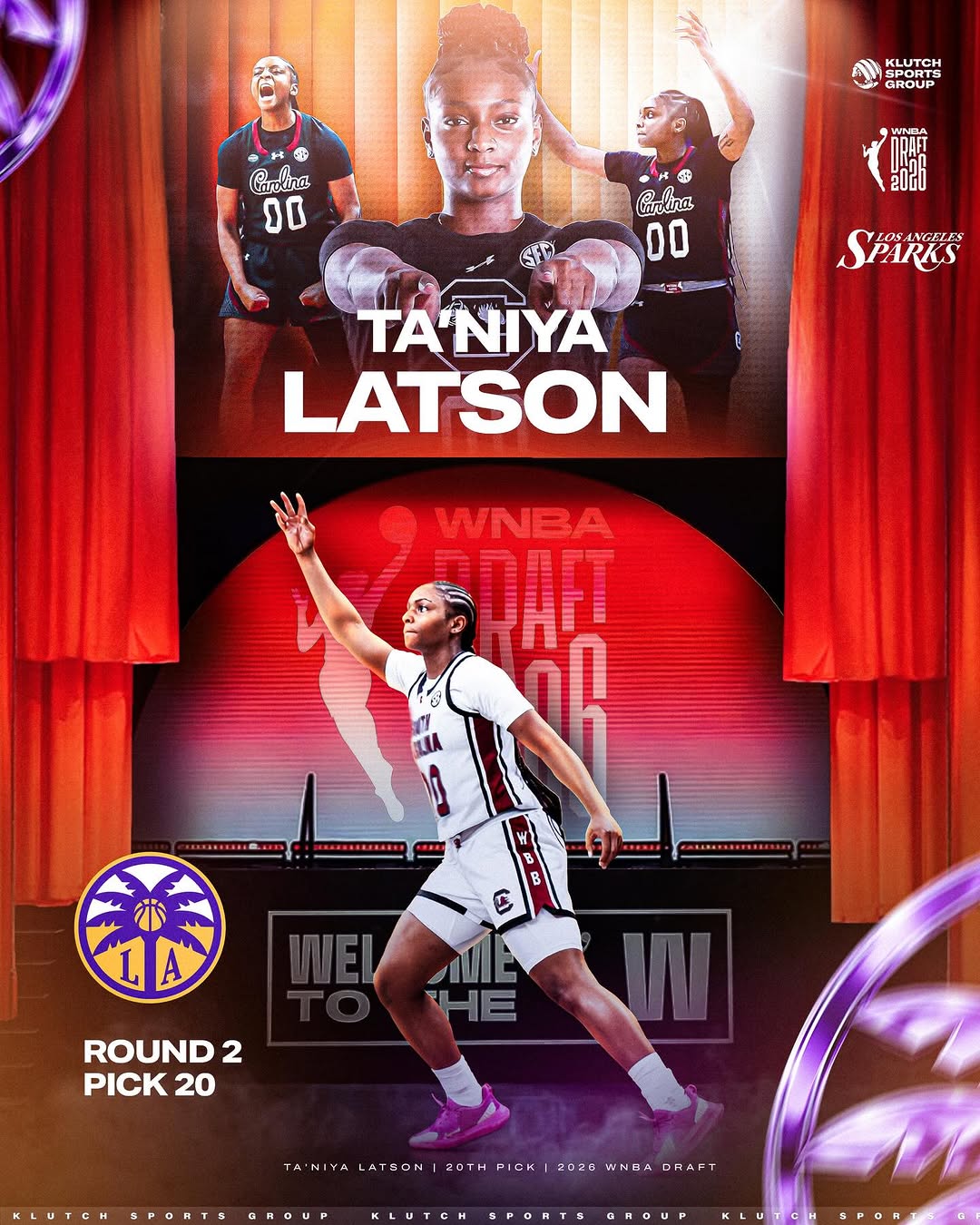
South Carolina guard Ta’Niya Latson was selected by the Los Angeles Sparks with the No. 20 overall pick in the second round of the 2026 WNBA Draft on Monday night — the third and final Gamecock selected on a historic evening for Dawn Staley’s programme, joining first-round picks Raven Johnson and Madina Okot.
The Slide That Will Fuel Everything
Latson’s drop to the second round came as a genuine surprise. Multiple outlets had projected her as a first-round selection, and her statistical profile across four college seasons more than justified that expectation. Yet draft nights have a way of producing outcomes that defy projections — and rather than dwell on the slide, Latson chose to frame her landing spot with the composure of someone who has always found a way to prove doubters wrong.
“It’s just a surreal moment,” Latson said. “It’s a dream come true. LA is a great city. I love the culture that they have there. I’m excited to meet my coaches, my teammates. I’m just ready to get to work.”
No bitterness. No deflection. Just pure focus on the opportunity ahead. That response, in itself, says a great deal about the mental makeup of the player Los Angeles just acquired.
Four Years of Building Toward This Moment
To fully appreciate what Latson brings to the Sparks, you have to understand the full arc of a college career that was never short on production but evolved significantly in its final chapter.
Latson first made her name at Florida State, where she spent three seasons becoming one of the most prolific scorers in the country. She was the ACC Rookie of the Year before establishing herself as a perennial All-ACC selection across three campaigns. In her junior season, she earned All-American honours while leading the entire nation with a staggering 25.2 points per game — a figure that announced her as one of college basketball’s elite offensive forces. Across her three seasons with the Seminoles, she averaged 21.3 points per game and started all 128 games she played during her college career, building a reputation as a relentless scorer who could create her own shot against any defence.
But scoring at volume and becoming a professional are two different things, and Latson understood that distinction better than anyone.
The South Carolina Effect
The decision to transfer to South Carolina for her final college season was deliberate and calculated, and it paid off in ways that directly strengthened her professional case. Under Dawn Staley — one of the most respected architects of complete players in the history of the game — Latson transformed from a high-volume scorer into a genuinely well-rounded guard.
She started all 35 games in her lone Gamecock season and averaged 14.1 points, 2.9 rebounds, 3.6 assists, and 1.7 steals per game. Crucially, the efficiency numbers told the story of her growth most powerfully — she posted career-highs in field goal percentage (48.6%), effective field goal percentage (52.2%), and true shooting percentage (57.5%). These are not marginal improvements. They represent a fundamental shift in how Latson approached the game — prioritising quality over quantity, and winning over individual numbers.
The college game rewarded her growth accordingly. She earned All-SEC second-team honours, an NCAA All-Tournament team selection, and was a finalist for the Ann Meyers Drysdale Shooting Guard of the Year Award. Across her full college career, she averaged 20.2 points, four rebounds, and 3.8 assists per game — a résumé that speaks to consistent excellence at every stop.
Latson herself was unambiguous about why she made the move to Columbia, and what she achieved there.
“I went to South Carolina to become a pro and get ready for the league,” she said. “I feel like I’m well-prepared.”
That confidence is not arrogance — it is the earned conviction of a player who did exactly what she set out to do.
What Los Angeles Is Getting
The Sparks were in need of perimeter playmaking, and in Latson, they have acquired one of the most dynamic scoring guards to enter the draft. Her primary gift — the ability to get downhill, create separation, and finish at the rim or pull up in the mid-range — is precisely the kind of skill that translates to the professional game. She is not a one-trick scorer. She is a player whose game expanded each season, and whose final college year demonstrated an ability to operate within a system, make teammates better, and defend at a high level.
She will also benefit enormously from learning alongside Kelsey Plum — another elite college scorer who had to evolve and diversify her game to thrive in the WNBA. The parallels between their developmental paths make that mentorship pairing one of the most naturally fitting in the entire draft class.
Latson made clear that she arrives in Los Angeles with full awareness of what she offers and an eagerness to prove it on the biggest stage.
“Obviously God wanted me here for a reason, and I’m going to take it in with everything that I have,” she said. “I know I can bring my ability to get downhill and score the ball. I’m a two-way player too, and I can bring a lot of other things to the table, and I’m a really good teammate. So I’m just excited. I’m ready to win.”
The Bigger Picture
Ta’Niya Latson has spent her entire career defying the limitations others have tried to place on her — a scorer who became a complete player, a star who became a winner, a projected first-rounder who became a second-round pick with something to prove. Los Angeles may have gotten one of the best value selections of the entire draft.
The slide to No. 20 will not be remembered for long. What will be remembered is what Latson does with the opportunity. And based on everything she has shown across four remarkable college seasons, that story is going to be very worth watching.
About The Author