South Carolina’s 2027 Recruiting Puzzle: Fewer Spots, Sharper Priorities
As the 2027 recruiting cycle begins picking up steam — with visits filling calendars and early commitments starting to flow in — the more pressing question for South Carolina isn’t really about which prospects the staff wants. It’s about how many roster spots will actually exist to fill.
A recruiting class shaped by roster math, not just talent
Unlike last year’s massive haul, this cycle is shaping up to be considerably smaller by necessity — and that’s arguably a fortunate coincidence rather than a problem. The 2027 class is unusually top-heavy, loaded with elite talent at the very top but lacking the depth that defined the 2026 group. Landing a large, deep class last year and a smaller, more targeted one this year works out about as well as recruiting cycles can align.
There’s also a structural shift worth flagging. With the new 5-for-5 eligibility framework now in play, South Carolina and virtually every other program chasing national championships will increasingly look to solve roster needs through the transfer portal rather than leaning as heavily on traditional high school recruiting. That’s a real departure from how rosters have historically been constructed, and it’s likely to shape not just this cycle, but multiple ones going forward.
Counting the actual scholarship math
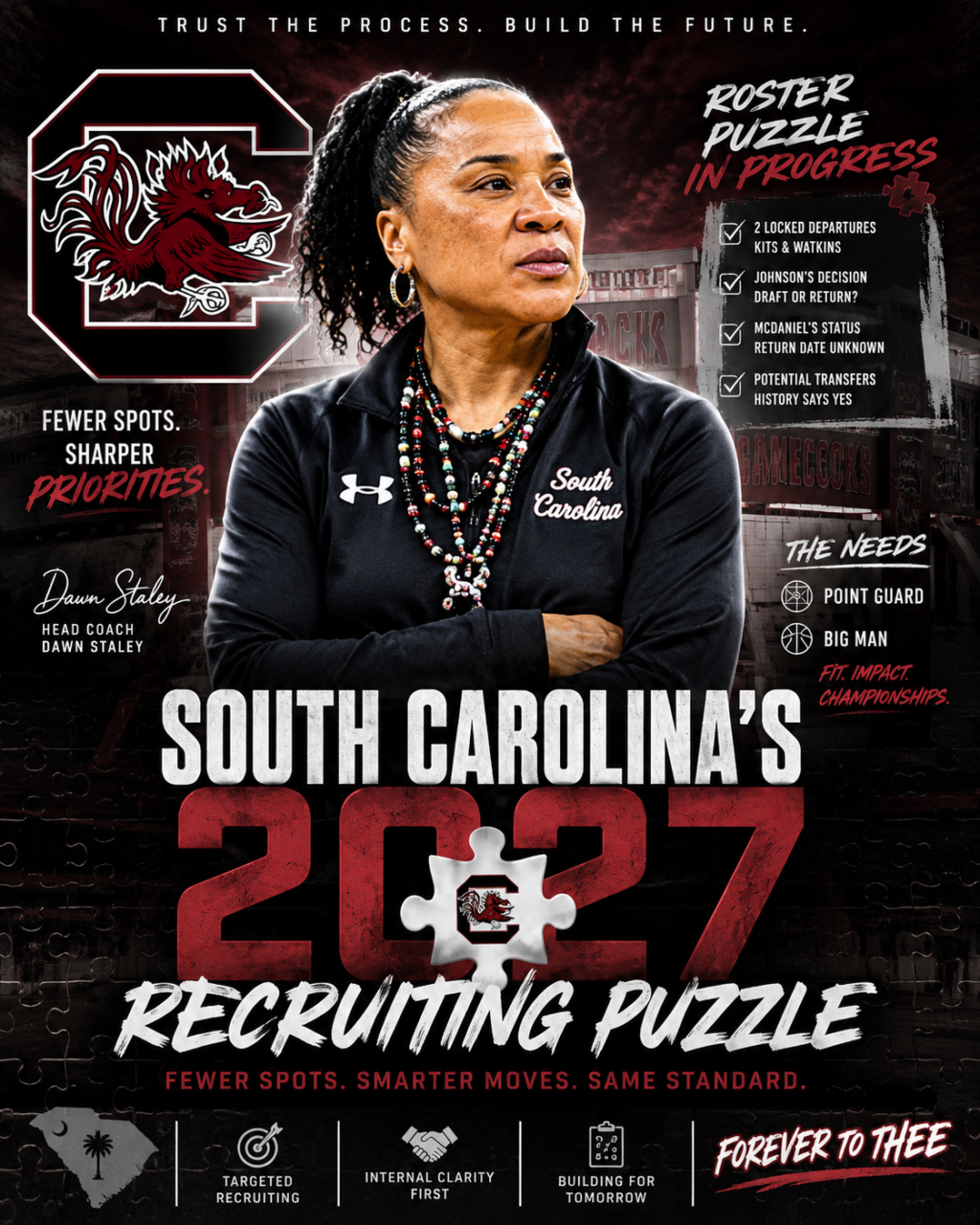
Here’s where things get complicated. South Carolina is planning for a full 15-player roster heading into 2026-27, and only two departures are locked in for certain: Chloe Kitts and Ashlyn Watkins, both of whom will have exhausted their eligibility. That guarantees exactly two open scholarships — but the real number could end up considerably higher.
Two more situations remain genuinely unresolved. Tessa Johnson is technically a senior this season, but the 5-for-5 eligibility rules give her the option to return for a super senior year instead of entering the WNBA Draft, where she’s currently projected as a first-round pick in early mock drafts. That’s a decision with real stakes on both sides — a program hoping to keep an elite three-point shooter, and a player weighing a near-certain first-round payday against one more collegiate season.
Maddy McDaniel adds a second layer of uncertainty. She’s currently on leave from the team with no confirmed return date, and while she technically has three more years of eligibility starting next season, her scholarship spot remains in limbo until she makes a decision either way.
And then there’s the simple reality of roster attrition. Even with South Carolina’s strong recent track record of retaining players, history suggests at least one transfer departure is likely. The program has lost players via transfer in every recent cycle — three in 2022, one in 2023, one in 2024, and two in 2025 — making it improbable this year breaks that streak entirely.
Add it all up, and South Carolina is guaranteed at least two open scholarships, but the realistic range stretches as high as five, with three or four being the more probable outcome.
Why the internal decisions come first
That range matters enormously for how this recruiting cycle actually unfolds. Building a class around two open spots looks nothing like building one around five, which means the coaching staff’s first real task isn’t hitting the road — it’s getting clarity at home. Whether McDaniel returns, and when, along with whether Johnson chooses to use her extra season or declare for the draft, will shape everything else that follows.
This is precisely the kind of situation where a program’s internal relationships and trust matter most. Neither McDaniel nor Johnson is a fringe roster piece a staff could simply nudge out to create space — both are core, meaningful contributors. But that same importance cuts both ways: South Carolina can’t afford to be caught flat-footed on the recruiting trail if either ultimately decides not to return.
Filling the gaps that actually exist
Once the roster picture becomes clearer, South Carolina’s on-court needs are fairly well defined: a point guard and a big man are the priorities. The 2027 class, unfortunately, only cooperates with half of that equation.
This cycle runs deep at point guard and offers no shortage of talented, physical wings, but genuinely difficult-to-find impact bigs are scarce across the board. That mismatch means South Carolina will likely be satisfied landing one, possibly two, point guards along with a wing from this class — while the frontcourt need may have to be addressed differently, either through internal development of current roster pieces or, more likely given the current recruiting landscape, through the transfer portal instead.
The bigger picture
Ultimately, this cycle looks less like a straightforward talent hunt and more like a calculated, need-specific build — one where roster clarity at the top has to arrive before the class beneath it can really take shape. With national championship expectations attached to every South Carolina roster, expect the staff to prioritize fit and immediate impact over simply chasing rankings, particularly at the position — big man — where high school recruiting alone may not be enough to solve the problem.
About The Author