
“The Huge Support From Gamecocks Fans Left Him Completely Speechless”
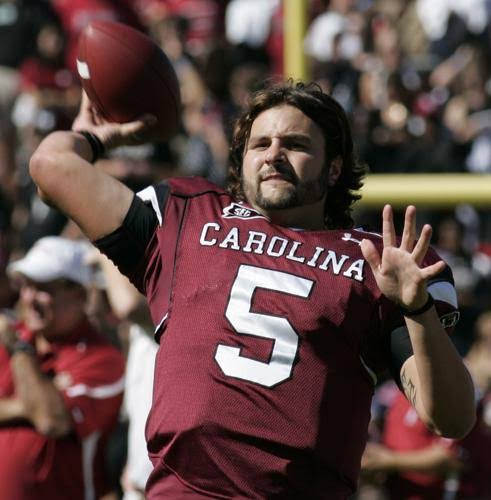
The former South Carolina quarterback is facing the biggest fight of his life, and the response from the college football world has left him speechless
Stephen Garcia has faced pressure before. He spent five years as the starting quarterback at South Carolina, took snaps in packed SEC stadiums, and navigated the scrutiny that comes with being the face of a major college football program. He has known what it means to fight through adversity in front of thousands of people. But nothing — not a single snap, not a single setback — could have prepared him for the moment he came out of a colonoscopy and looked at his wife’s face.
Maria Garcia was sitting beside him, tears streaming down her face. Stephen, still shaking off the anesthesia, couldn’t process what the doctors were telling him. He didn’t need to. His wife’s expression told him everything he needed to know.
He had Stage 4 colorectal cancer.
“I kind of was like, ‘Well, that kind of sucks,'” Garcia told reporters on May 8. “‘That’s pretty shitty news. What now?’ Because we had no idea what was going on.”
A Pain He Ignored — Until He Couldn’t
The road to that diagnosis began as so many serious medical stories do: with a symptom that seemed easy to dismiss. Garcia, now 38 and living in Tampa, Florida, first noticed pain in the lower left side of his abdomen last July. Like many men his age, he figured it was nothing — perhaps irritable bowel syndrome, something that would pass on its own without any intervention.
It didn’t pass. Months went by, and as Garcia put it, “it just never ended.” That’s when Maria stepped in and pushed him to get an ultrasound.
What that ultrasound revealed set off a cascade of increasingly alarming medical findings. “When I got an ultrasound, the ultrasound noticed a few spots on my liver, and they recommended getting an MRI. So we got the MRI, they found two lesions on the right side of the right lobe of the liver, and they said, ‘You’ve got to go get a colonoscopy immediately,'” Garcia recalled. “So we did, and the guy went up there and said he was 13 centimeters up and said, ‘I can’t pass through there without knocking anything down. We’re going to order a biopsy to make sure it’s the same cancer, because that’s what we think it is.’ They matched. So it started when the colon trickled into the liver.”
The diagnosis confirmed what the imaging had suggested: the cancer had originated in the colon and spread to the liver. Stage 4. The kind of news that stops a room cold.
Garcia publicly revealed his diagnosis for the first time last Wednesday — the same day he began chemotherapy treatment.
The Game Plan: One Bite at a Time
What makes Garcia’s response to this diagnosis so striking is not the bravado — it’s the clarity. There is no denial here, no performative toughness masking fear. He acknowledges that the road ahead is hard. But he has refused to let that reality become a reason to stop moving forward.
His doctors have been direct with him about what to expect from chemotherapy, telling him there will be days when the treatment knocks him flat. But they have also encouraged him to stay active, keep training, and maintain the physical foundation that gives him an advantage in this fight.
“The doctor said there are going to be times where this game is going to whip your ass and you’re not going to feel like moving, but we encourage you to continue training, continue working out, continue staying active. Don’t set any PRs on bench or squat, but continue to lift weights,” Garcia said. “But yeah, as far as the day-to-day goes, it’s changed drastically.”
The day after his first chemotherapy session, he was back in Tampa training young quarterbacks. That’s not recklessness — that’s a man who understands that purpose and routine are as essential to survival as medicine.
Garcia’s mental framework for the fight ahead is rooted in something he read long ago, a philosophy he has clearly carried with him through years of challenges far smaller than this one.
“There’s a book that I read a long time ago, ‘No Easy Day.’ It’s about Navy SEALs. And one of the things that I’ve always remembered is, ‘How do you eat an elephant?’ And it’s, ‘One bite at a time,'” he said. “So that’s the model I’m going with right now. Just taking one day at a time and trying to stay as positive as possible. We’re going to kick this thing in the teeth and knock it out. There is no other option. There is no other plan B; this is what we’re doing. And I have complete faith in the team that I have around me.”
Doctors, for their part, are confident. Garcia’s overall health and active lifestyle — outside of the cancer itself — give him a meaningful edge, and medical teams have expressed belief that he can overcome it.
When Rivals Become Friends: College Football Rallies Around One of Its Own
Perhaps nothing about this story has been more moving than the response it has generated across the college football world. Garcia spent his playing days in one of sport’s most competitive environments, where rivalries run deep and loyalties are tribal. The outpouring of support he has received since going public has transcended every one of those boundaries.
Former teammates, coaches, and even opponents from the other side of fierce SEC rivalries have reached out to offer support. The list of names Garcia rattled off captures just how wide that net has been cast.
“The fact that AJ McCarron reached out, Roll Tide Willie reached out, you know, the guys from Auburn, just all over the country, Dabo Swinney, he’s literally texting me right now, Coach (Shane) Beamer, Jeremiah (Donati), the athletic director at South Carolina. He’s like, you know, ‘We have a plan. We’re going to have a meeting today, and we’re going to pull through for you,'” Garcia said.
Think about the significance of that for a moment. Dabo Swinney — the head coach of Clemson, South Carolina’s most bitter rival — texting Garcia in real time during a press conference. AJ McCarron and fans from Alabama and Auburn, programs that spent years trying to beat Garcia on the field, picking up the phone to check on him. These are not obligatory gestures. These are people who, regardless of what side of the field they stood on, recognize a human being worth fighting for.
Garcia’s phone, he noted, has died roughly 50 times from the volume of messages pouring in. He has been trying to respond to every single one.
“There’s so many people that have come together and it’s been wild to see,” he said. “My phone’s here. It’s died like 50 times already because I’m just trying to respond to everybody and just make sure they know that I’m genuinely extremely thankful for them even caring about what I have to do and what I’m going through.”
A Community That Has Shown Up
Beyond the messages, the financial response has been nothing short of remarkable. Garcia and his family launched a GoFundMe page that, as of this writing, has raised more than $225,000 toward its $250,000 goal. The contributions have come from all directions — strangers sending $7 at a time alongside others writing checks for $5,000 and $10,000.
“It’s truly humbling. I say that, and I’ve said that over the last few days, of just how humbled I am for these people that I have no idea who they are,” Garcia said. “I mean, there’s people that are sending $7 at a time. There’s people that are sending $5,000, $10,000. It’s truly amazing.”
There is something deeply important about that detail — the $7 donors matter just as much to Garcia as the large checks. This is not a story about celebrity fundraising. It is a story about a community of people, many of whom have never met Stephen Garcia, deciding that his fight is worth showing up for.
Built for This
Stephen Garcia was never the most conventional quarterback. His time at South Carolina was defined as much by turbulence as triumph, and his relationship with the program and its fanbase was complicated. But in this moment, none of that history carries any weight. What remains is a man — a husband, a father, a coach, a fighter — staring down the most serious challenge of his life and refusing to blink.
He believes he was built for this. Not because of arrogance, but because of everything he has been through — and everything he has learned — in the decades since he first stepped onto a football field.
There is no other option. There is no plan B. And if the first week of this fight is any indication, Stephen Garcia is exactly the kind of person who finds a way.
About The Author