USA Basketball Just Assembled 22 Of The Most Elite Young Players In The Country — And Several Have South Carolina Written All Over Their Future
The pipeline that feeds the United States women’s basketball program at every level does not happen by accident. It is built through years of identification, development, and systematic investment in the country’s most talented young players — and the 22 athletes selected to participate in the 2026 USA Basketball Women’s U18 National Team trials represent the clearest possible snapshot of where that pipeline currently stands.
Trials begin May 30 at the U.S. Olympic and Paralympic Training Center in Colorado Springs, Colorado, with a 12-member team expected to be named at the conclusion of the selection process. That team will compete at the 2026 FIBA U18 Women’s AmeriCup, scheduled for June 9-15 in Irapuato, Mexico — where the United States will attempt to capture its 12th consecutive gold medal and 13th overall since the tournament’s inception in 1988.
Those numbers are not simply a statistic. They are a statement of institutional dominance that places extraordinary competitive pressure on every team that wears USA across its chest at this level. Winning is not the goal. Extending a legacy is.
The Roster — And What It Tells Us About The Future Of Women’s Basketball
The 22 athletes invited to trials span three graduating classes — 2026, 2027, and 2028 — and the cross-class composition reflects a deliberate developmental philosophy. USA Basketball is not simply selecting its best available players for a single tournament. It is simultaneously identifying and pressure-testing the talent that will represent the country at progressively higher levels over the next several years.
The class of 2026 contingent includes Kelsi Andrews, Cydnee Bryant, Oliviyah Edwards, Bella Flemings, Jayla “Jordyn” Jackson, Julia Scott, and Morgan Stewart. Several of these names carry immediate South Carolina relevance. Andrews and Edwards are both incoming Gamecocks — part of the celebrated 2026 recruiting class that Dawn Staley has assembled — meaning two members of South Carolina’s own roster will be competing against each other for spots on the U18 national team before they have played a single minute together in Columbia. That is an extraordinary measure of the class’s collective talent.
The class of 2027 group is arguably the most star-studded subset of the entire trial pool: Haylen Ayers, Jezelle “GG” Banks, Ryan Carter, Jayla Forbes, Miciah “Mimi” Fusilier, Jada Jackson, Tatiana Mason, De’Andra Minor, Jordyn Palmer, Qandace Samuels, Sydney Savoury, Zya Small, and Kaleena Smith. Banks and Smith are among the most heavily recruited players in the country — South Carolina’s primary point guard targets in the class — while Palmer has separately emerged as a Gamecock recruiting priority. The 2027 class representation at these trials is, in many respects, a preview of what the next major recruiting battleground in women’s college basketball looks like. The programs that land the most players from this group will be defining their rosters for years to come.
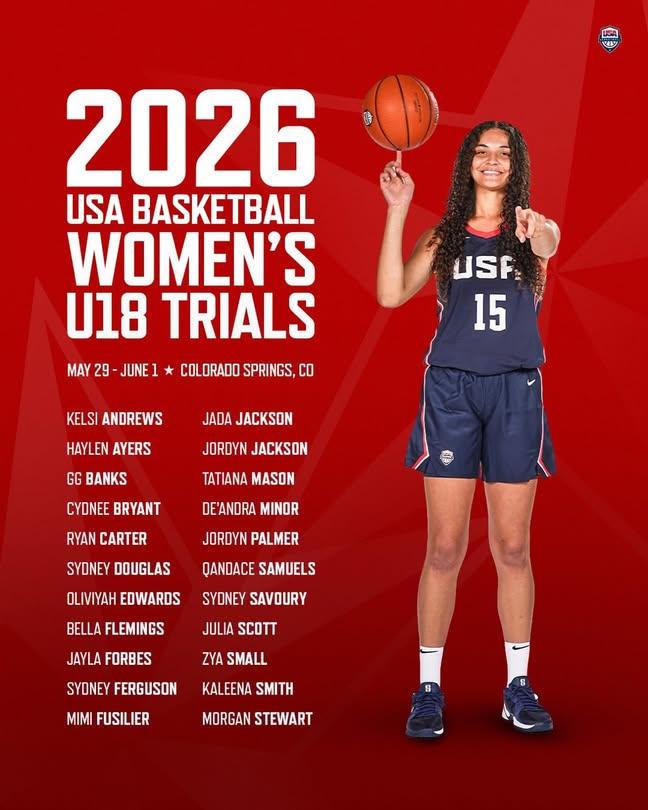
Representing the class of 2028 — the youngest athletes in the pool — are Sydney Douglas and Sydney Ferguson. Their inclusion at this level, two full years before their high school graduation, signals the kind of extraordinary early development that USA Basketball reserves for its most exceptional young prospects.
Experience Versus Debut — The Competitive Dynamic At Trials
One of the most analytically interesting dimensions of the trials pool is the sharp divide between athletes with established USA Basketball experience and those making their debut on this stage.
Six athletes — Cydnee Bryant, Sydney Ferguson, Jada Jackson, Julia Scott, Zya Small, and Morgan Stewart — will be experiencing USA Basketball for the first time at these trials. For these players, the Colorado Springs environment represents an entirely new competitive context: elite training facilities, national team coaching staffs, and competition against peers who have already navigated this exact environment in previous years. The learning curve is real, and how they handle it will be a meaningful part of what selectors evaluate.
On the other end of the experience spectrum, athletes like Kaleena Smith, Jezelle Banks, Qandace Samuels, Sydney Douglas, Ryan Carter, and Haylen Ayers arrive having participated in USA Basketball events across multiple years — some as recently as the April minicamp in Phoenix. Edwards herself has USA Basketball experience dating to 2023, spanning three separate years of national team involvement across different age groups. That accumulated experience represents a competitive advantage that goes beyond skill — these are athletes who understand the culture, the expectations, and the evaluation process in ways that first-timers simply cannot replicate immediately.
Four athletes arrive with the additional distinction of international medal experience: Andrews, who medaled at the 2024 FIBA U17 World Cup and the 2023 FIBA U16 AmeriCup; Douglas, who earned gold at the 2025 FIBA U19 World Cup; Jordyn Jackson, who medaled at the 2023 FIBA U16 AmeriCup and most recently represented the U.S. in a 104-77 victory over the World Select Team at the 2026 Nike Hoop Summit; and Palmer, who medaled at the 2024 FIBA U17 World Cup. These four players have already performed on international stages under genuine competitive pressure — an experience that is not replicated in any domestic setting regardless of its quality.
The Coaching Staff — A Legitimate All-Star Panel
The leadership assembled for the 2026 U18 program reflects USA Basketball’s commitment to placing its junior national teams under genuinely elite coaching guidance rather than treating the youth program as a developmental assignment for inexperienced staff.
Head coach Niele Ivey brings the credibility of leading one of women’s basketball’s most historically significant programs at Notre Dame — a program with a championship pedigree and a reputation for developing guards in particular that is unmatched outside of a handful of elite programs nationally. Her assistants are equally accomplished: Robyn Fralick has built Michigan State into a legitimate Big Ten contender, while Charmin Smith brings the perspective of leading a Pac-12 — now ACC — program at California.
The court coaches supporting the trials add further depth to an already distinguished panel. Megan Griffith, in her first USA Basketball coaching assignment, has led Columbia to three consecutive Ivy League regular season titles and earned Ivy League Coach of the Year recognition in 2023, 2024, and 2025. Scott Rueck brings Final Four experience from Oregon State in 2016, nine NCAA Tournament appearances, and a national championship at George Fox University in 2009. Rueck also carries prior USA Basketball experience as an assistant at the 2015 Pan American Games.
The breadth of coaching perspective represented — Power Conference programs, mid-majors, Ivy League, international competition — ensures that the evaluation of 22 diverse players will be conducted through multiple analytical lenses simultaneously. That is a deliberate strength of USA Basketball’s selection process.
The Tournament Landscape — What Stands Between USA And Gold Medal No. 12
The United States enters the 2026 FIBA U18 Women’s AmeriCup carrying the weight of 11 consecutive gold medals and a legacy that has made American women’s basketball at this age group the global standard against which all competition is measured. The pressure that creates is unique — not the pressure of being the underdog trying to prove something, but the pressure of a dynasty trying to sustain what has been built.
Placed in Group B, the Americans open tournament play on June 9 against Argentina before facing Mexico on June 10. The U.S. holds a perfect 6-0 all-time record against Mexico in this competition, and the June 10 matchup provides an opportunity to extend that record against a host nation that will carry its own emotional investment in the contest. Group B play concludes June 12 against Paraguay — the two nations’ second meeting in U18 competition, with the U.S. having won their 2006 encounter.
Knockout rounds begin June 13 with the quarterfinals, followed by semifinals June 14 and medal games June 15. The tournament’s compressed six-day format demands physical resilience and roster depth — qualities that a 12-person team selected from a 22-person trial pool should possess in abundance.
The South Carolina Connection — Why This Matters For The Gamecocks
For South Carolina women’s basketball specifically, this trial pool is a living recruitment map. Andrews and Edwards competing at trials before arriving on campus. Banks, Smith, and Palmer — three of the program’s most heavily pursued future targets — demonstrating their elite credentials on the national team stage. The performance of those players at Colorado Springs and potentially in Mexico will shape recruiting conversations, confirm or challenge existing evaluations, and provide Staley’s program with real-time competitive intelligence on the players it is investing in.
Programs that produce USA Basketball players at this level do not do so by accident. They do so because they have built recruiting pipelines deep enough to access the country’s genuine elite — and because the players they recruit understand that choosing the right program means continuing to be seen, evaluated, and developed at the highest levels of the game.
The trials begin May 30. Twelve spots are available. Twenty-two players want them.
What happens in Colorado Springs over the next several days will matter far beyond the tournament in Mexico that follows.
About The Author