
Beamer, Donati and the CFP Expansion Debate: Where South Carolina Stands
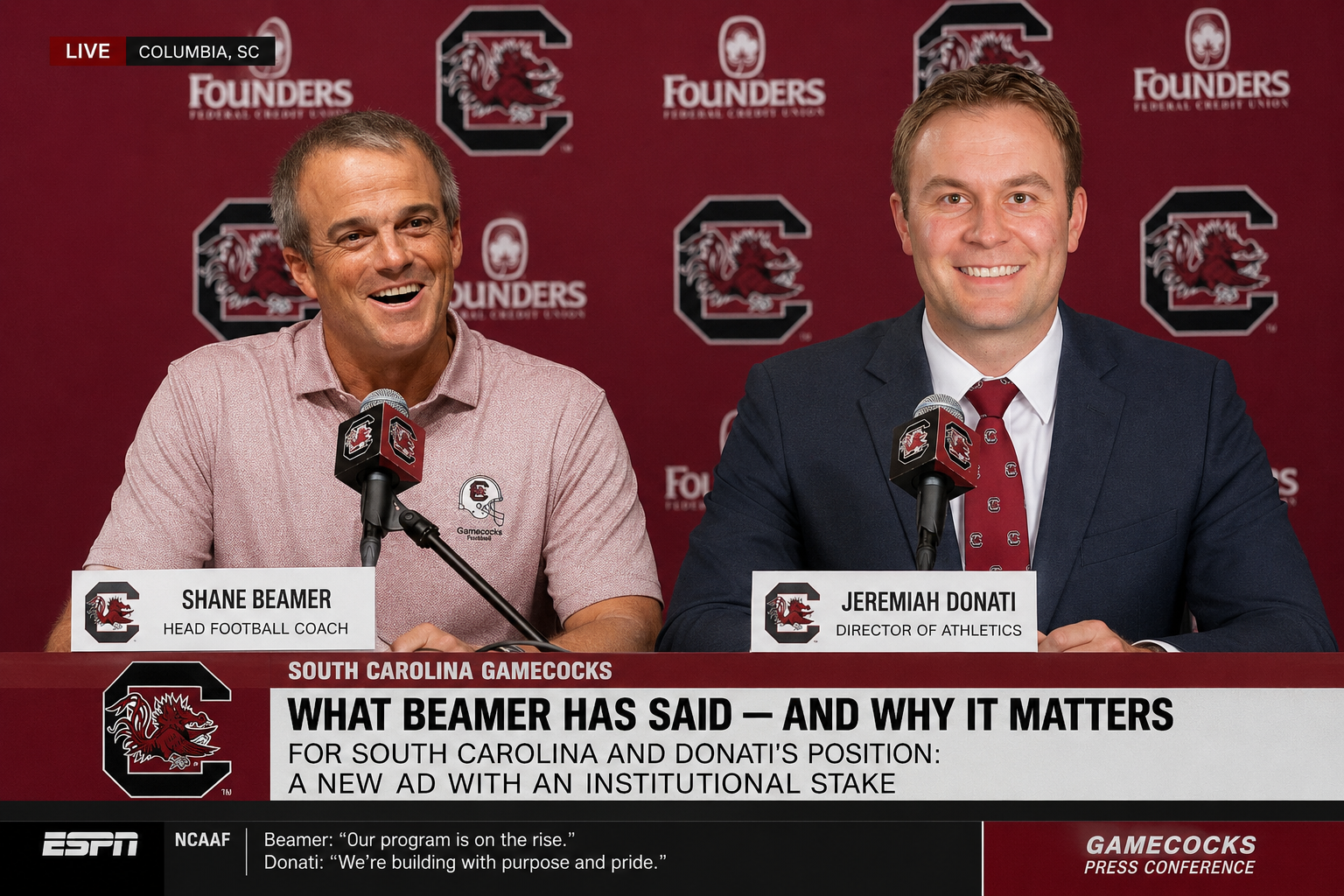
COLUMBIA — Money, as it always does in modern college athletics, is driving everything. The debate over whether to expand the College Football Playoff from its current 12-team format to a proposed 24-team bracket is fundamentally a financial negotiation dressed in the language of competitive fairness — and South Carolina head coach Shane Beamer and athletics director Jeremiah Donati are watching it closely, with perspectives shaped by recent history and a genuine investment in what makes college football worth watching in the first place.
The debate is real, even if resolution remains elusive. No formal steps have been taken, and the 12-team format has been confirmed for the 2026 season. But the conversations happening behind closed doors — in Dallas, in Jacksonville, in Washington — may prove among the most consequential in the sport’s modern era.
The Fault Lines: Three Conferences Against One Commissioner and a Network
The battle lines are clearly drawn. The Big Ten, which first proposed the 24-team model and has won the last three national championships, is the primary architect of expansion. The ACC’s coaches and athletic directors have since voiced unanimous support for doubling the field, joining the Big 12 in a coalition that represents a numerical majority of college football’s power structure — but not its two most powerful members.
ACC commissioner Jim Phillips made the pro-expansion case plainly: “When you’re leaving national-championship-contending teams out of the playoff, you don’t have the right number.” It is an emotionally resonant argument, easy to sell to fanbases who have watched deserving programs sit home while less accomplished ones received invitations.
Standing firmly in opposition is SEC commissioner Greg Sankey, who has made his position unmistakably clear: 16 teams is the ceiling, and he is not moving. His resistance is grounded not just in philosophy but in contract law. The SEC’s deal with Atlanta’s Mercedes-Benz Stadium was extended in 2023 through at least 2031, locking the conference championship game into its current window regardless of what other conferences decide they want. When asked about the push to eliminate conference title games under a 24-team format, Sankey was characteristically direct:
“We have contracts,” he said. “Opinions are expressed, but we have a contract, so we have a championship game.”
That sentence is not merely a statement about the SEC Championship Game — it is a signal that Sankey views the 24-team push as an exercise in wishful thinking that bypasses existing legal obligations, and that he has no intention of allowing conference enthusiasm to override contractual reality.
Perhaps the most surprising voice in the room belongs to a broadcast partner, not a commissioner. ESPN — which holds exclusive rights to the CFP through the 2031-32 season under a six-year, $7.8 billion deal — has reportedly made its preference clear. According to Phillips himself, the network “has been pretty clear with all of us that they’d like it to stay at 12, maybe 14, but no higher than 16.” The explanation is structural: ESPN’s existing deal was built for a 12- or 14-team field. Beyond 14 teams, additional games become available for competing networks to bid on, which would fracture ESPN’s monopoly on a product it paid nearly $8 billion to own exclusively. The network’s financial self-interest and Sankey’s institutional position happen to align — a combination that represents a formidable obstacle for the expansion camp.
The Revenue Math Nobody Can Solve
At the center of this debate is a number that nobody can pin down with confidence: how much additional money would a 24-team playoff actually generate — and would it offset what would be lost?
CFP executive director Rich Clark acknowledged the complexity directly: “I wish you could say that it was just about changing the format, but when you look at everything that it impacts, we don’t want to leave a stone unturned and make a decision that’s going to have second- or third-order effects that we didn’t consider.” Clark confirmed that conversations remain focused on 16- and 24-team fields, with the 12-team format still a possibility, and that any decision must be approved by December 1 to take effect the following season.
The current 12-team structure generates roughly $1.3 billion annually. A 24-team bracket would add 12 games — more than doubling the existing playoff — with the top eight seeds receiving first-round byes and opening-round games hosted at higher seeds’ campuses. But media consultants who have examined the financial projections estimate those first-round games, many of which would feature three- and four-loss programs, could be worth as little as $10 million or as much as $25 million apiece. That wide range reflects genuine uncertainty about the market value of a diluted product. And critically, most pro-expansion financial projections fail to account for the broadcast revenue currently generated by conference championship games — money that disappears entirely under a 24-team format that eliminates those events from the calendar.
The honest answer is that nobody truly knows whether 24 teams generates more money than 12. And making an irreversible structural decision based on projections that carry that degree of uncertainty is a risk even the most aggressive expansion advocates should acknowledge.
What Beamer Has Said — and Why It Reflects South Carolina’s Position
Shane Beamer enters 2026 with something to prove, and his perspective on expansion is shaped directly by his program’s experience on the bubble. South Carolina finished the 2024 regular season at 9-3 — good enough, by most reasonable measures, to warrant a playoff spot — only to land 14th in the CFP’s final rankings, one position outside the 12-team field. That experience informed Beamer’s measured support for expansion at the 2025 SEC Media Days:
“I’m all for expansion to give more teams opportunities. I wanted to make sure — we have the greatest regular season in any sport in college athletics in my opinion. You want to make sure that the regular season doesn’t lose meaning, and [I’m] confident that it won’t, if we expand. It’ll still make a lot more games meaningful in the month of November. And then gives more teams opportunities to go compete for a championship, which is what everybody wants.”
That framing is important. Beamer is not a blank-check endorser of the 24-team model — he is a coach who understands the institutional argument that college football’s regular season is its most valuable product. His position aligns naturally with 16 teams as a defensible middle ground: enough expansion to include programs like his 2024 Gamecocks, without enough inflation to drain November of its meaning. He specifically cited South Carolina’s Thanksgiving rivalry game against Clemson as an example of late-season football carrying real playoff stakes — a kind of urgency that a wider bracket would significantly diminish.
The 2025 season tested his credibility to make that argument. After entering the year ranked 13th nationally, the Gamecocks collapsed to a 1-7 conference record, the offense unraveling in ways that cost Beamer his offensive coordinator and offensive line coach mid-season. The low point came at Texas A&M, where South Carolina built a 30-3 halftime lead before surrendering 28 unanswered points in what became the largest comeback in Aggies program history. Despite the wreckage, athletics director Jeremiah Donati confirmed Beamer would return for a sixth season. Beamer, for his part, was direct about what comes next:
“We’re not there right now, but I do know next year at this time, we’re going to be sitting here on this Tuesday night watching the playoff rankings to see where we are in the ranking show. And we’re going to be firmly in the mix for a College Football Playoff berth next year at this time.”
Whether that declaration proves prophetic or premature will depend heavily on what he does with the offseason — specifically, who he hires as his fourth offensive coordinator in six seasons.
Donati: A New AD Who Knows This Debate From Both Sides
Jeremiah Donati brings a background uniquely suited to this negotiation. Before arriving in Columbia, he spent years as athletics director at TCU — a program that understood better than most what it meant to exist at the edge of a playoff structure that didn’t always reward the deserving. He watched the Horned Frogs reach the College Football Playoff national championship game in 2022 under first-year head coach Sonny Dykes, navigating a system in which brand recognition sometimes mattered as much as performance. That experience gives him fluency in the expansion argument that SEC-only administrators often lack.
But Donati also oversees a program embedded in the SEC — a conference whose commissioner controls the most important vote in this debate. His institutional obligation and his experiential instincts may not always point in the same direction, and how he navigates that tension will say something about what kind of voice South Carolina has in the sport’s most significant structural conversation.
On the operational side, Donati remains focused on building the infrastructure for sustained competitiveness. Williams-Brice Stadium renovations are, in his words, “on time, on budget,” with the student section improvements expected to be ready for the 2026 kickoff. Those upgrades represent a long-term bet on the program’s relevance — and that bet is worth considerably more if the playoff structure continues rewarding programs capable of winning nine or ten games in the SEC.
The Structural Reality: What 24 Teams Would Actually Destroy
It is worth being precise about what a 24-team CFP would mean in practice, because the details expose trade-offs that the expansion narrative tends to gloss over.
Under the proposed format, conference championship games would be eliminated to accommodate the additional rounds. Georgia coach Kirby Smart, one of the sport’s most analytically minded coaches, captured the central tension: “I just don’t know where that line of demarcation is… I do feel like we’re going to make some of our regular season games maybe less meaningful, less impactful, but they’ll still matter in the grand scheme of things, especially toward the end of the season.”
Even Clemson’s Dabo Swinney — whose program has the brand to thrive under almost any format — acknowledged the cost: “I don’t love those things going away, but I don’t see any other path forward, because, again, you’ve got to shorten the season.”
When coaches of that caliber are already mourning the trade-offs before a decision has been made, it is a reasonable signal that the cost is higher than the expansion advocates are advertising.
For South Carolina specifically, an honest look at Beamer’s record complicates the straightforward argument that 24 teams is good for programs at their level. In five seasons, 2024 was the only year the Gamecocks would have qualified for a 24-team field. That data point doesn’t invalidate the case for expansion — it simply contextualizes it. Access and contention are different things, and a playoff berth as the 22nd seed is a very different experience than competing for a national championship.
Where This Goes From Here
The CFP will remain at 12 teams for 2026. There will be a December 1 deadline each subsequent year for conferences to notify ESPN of any format changes — meaning the decision about what 2027 looks like will be made in the months immediately ahead.
The fundamental impasse between the Big Ten’s 24-team ambitions and the SEC’s 16-team ceiling has not narrowed. Sankey controls the most critical vote, and his position has not shifted. ESPN’s financial incentive reinforces his resistance. And the revenue projections for a 24-team format, while compelling on paper, carry enough uncertainty that even some expansion supporters are privately asking whether the math actually works.
What Beamer and Donati want, at their core, is a system that gives South Carolina a legitimate shot at the postseason in years when the program earns it — without dismantling the regular-season structure that makes college football worth playing and watching in the first place. That position is neither revolutionary nor naïve. It is, in fact, exactly what Greg Sankey has been saying all along — even if, for obvious reasons, it sounds different coming from Columbia than it does from the SEC offices in Birmingham.
College football has a decision to make. The question is whether the people making it understand what they’re risking.
About The Author