A Homecoming Story: Walker Mitchell Brings Talent, Legacy, and Grit to South Carolina Baseball
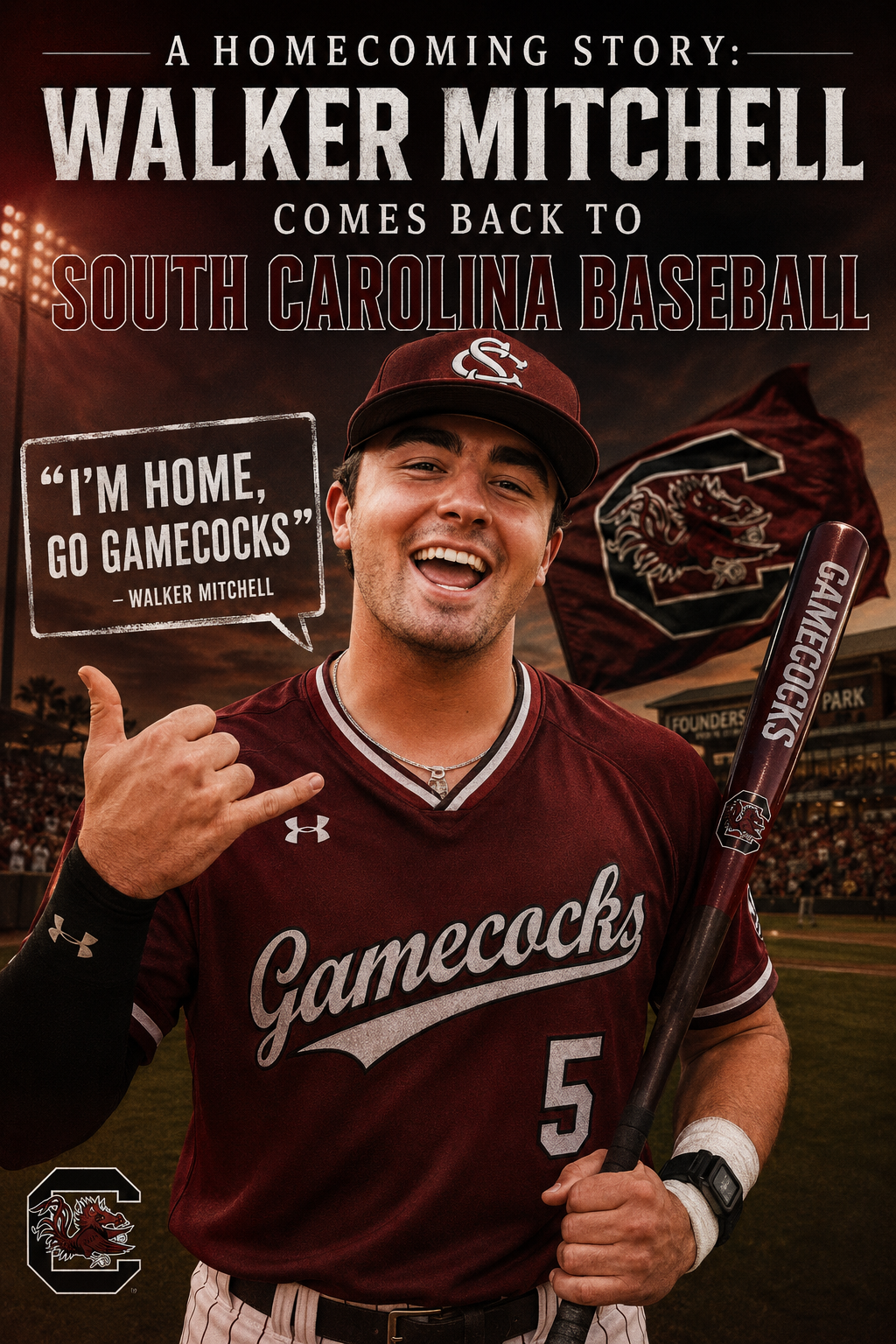
COLUMBIA, S.C. — Some transfer portal commitments are transactions. This one is a story.
When Walker Mitchell announced his commitment to South Carolina on Tuesday night, he did not reach for the standard language of portal culture — the polished graphics, the measured gratitude, the carefully worded statement. Instead, he wrote what he felt:
“God works in mysterious ways. I’m coming HOME! Go Cocks!”
For anyone who knows the Mitchell family’s history in Columbia, those words carry weight that goes well beyond a single baseball commitment. Walker Mitchell is the son of former Gamecock Allen Mitchell — a man who played both football and baseball at South Carolina in the 1980s, served as reserve utility player under coach June Raines on the diamond, and most famously split time as the starting quarterback during the legendary “Black Magic” 1984 football season alongside Mike Hold. The Gamecock bloodline runs deep in this family, and after Walker initially chose Coastal Carolina over South Carolina coming out of River Bluff High School in Lexington, this commitment closes a circle that was perhaps always destined to close.
But make no mistake: the sentimentality of this story does not overshadow the substance. Mitchell is not arriving in Columbia on the back of a family name. He is arriving as one of the most productive position players Kevin Schnall has coached — and as the most complete hitter in this entire portal class so far.
The Player: A Star Quietly Built at Coastal Carolina
Walker Mitchell’s three-year arc at Coastal Carolina reads like a textbook developmental success story. He arrived in 2024 as a freshman seeing limited action across nine games, got his feet underneath him, and then progressively became one of the most indispensable pieces of a program that reached the College World Series Finals in 2025 and returned to the NCAA Tournament in 2026.
By his junior season this past spring, Mitchell had evolved into Coastal’s offensive engine. He started all 60 games at third base, batted .313, posted a .431 on-base percentage, and led the entire Chanticleers offense in both batting average and on-base percentage. His 17 doubles ranked second all-time in Coastal Carolina’s single-season record books, and he finished with 54 RBIs — second on the team — while adding 11 stolen bases and nine sacrifice bunts. He also recorded 17 multi-hit games and 14 multi-RBI games, demonstrating the kind of consistent, game-in game-out production that defines a true middle-of-the-order presence.
Tie a bow on that junior season and it belongs in any conversation about the best offensive performances in the Sun Belt Conference this year. The .431 OBP in particular is a number that demands respect — it tells you Mitchell understands the strike zone, competes deep into counts, and refuses to give away at-bats. His team-high 21 hit-by-pitches also reveal something important about his approach at the plate: he crowds the zone, dares pitchers to work inside, and takes the bruises that come with it. That is not an accident. That is a competitor who understands how to manufacture offense by any means necessary.
His postseason usage is equally telling. When the games mattered most, Mitchell was batting leadoff — a designation that reflects total trust from the coaching staff in his ability to set the table, handle pressure, and ignite an offense on the biggest stages. For a player now heading to the SEC, that postseason experience in a Coastal Carolina program that consistently played deep into the tournament is invaluable preparation.
The Sophomore Leap and What It Tells Us
Mitchell’s 2025 numbers deserve a moment of analysis in isolation. He batted .270 with 55 hits, four home runs, and a .443 on-base percentage across 65 games — modest by the standard of his junior breakout, but notable for the OBP figure, which actually exceeded even his outstanding junior mark. His sophomore season was quieter in the batting average column but reflected a player who was learning the discipline and plate coverage that would fuel his 2026 explosion.
That pattern — a quieter sophomore season followed by a dramatic junior breakout — is among the most encouraging developmental trajectories a college hitter can show. It suggests the improvement was earned through work and adjustment, not simply statistical variance. Players who follow that arc tend to arrive at their peak right around the time Mitchell is arriving in Columbia, which bodes extremely well for his one-year window with the Gamecocks.
The Legacy Dimension: More Than a Name
The family backstory adds emotional texture, but it also adds genuine context for who Walker Mitchell is as a competitor. Growing up as the son of a man who played quarterback under the pressure of representing South Carolina football — in a season as iconic as the 1984 “Black Magic” run — shapes a kid in ways that are difficult to quantify but impossible to ignore. Competitive environments were not foreign to Walker Mitchell’s household growing up. Performing under pressure, carrying a program’s expectations, and understanding what it means to wear a South Carolina uniform were concepts absorbed long before he ever picked up a bat.
The fact that he initially chose Coastal Carolina over South Carolina coming out of River Bluff High School — picking the Chanticleers over his father’s alma mater — also speaks to his independence and his competitive instincts. He did not take the easy path to a legacy connection. He went to Coastal, proved himself on his own terms, and now arrives in Columbia having earned this homecoming through three years of hard work rather than simply inherited it.
One Year, One Mission
The limitation here is clear and must be addressed honestly: Mitchell will have just one year of eligibility remaining with the Gamecocks. In a portal class that already includes Colby Richardson and Daniel Parker with three years remaining and Hayden Johnson with two, Mitchell is the short-term investment — the veteran presence brought in to stabilize and lead an infield that is being rebuilt from scratch.
That context makes his production profile even more important. South Carolina cannot afford a developmental season from Mitchell. They need him ready on Opening Day, producing at or near his 2026 Coastal Carolina level, and serving as a stabilizing force for a team that will otherwise be leaning heavily on youth and inexperience across the roster. The good news is that nothing in his track record suggests he will need time to adjust. Players who lead their team’s offense in three major categories across 60 starts in a competitive conference do not typically arrive at their next program and struggle to find their footing.
His positional versatility — with experience at third base, second base, and shortstop — also gives Schnall significant lineup flexibility as the roster continues to take shape. In a rebuilding environment where the full picture of available talent is still being assembled, a player who can cover multiple infield spots without a drop in defensive quality is exactly the kind of Swiss Army knife a coaching staff needs.
The Schnall Effect: One Hire, One Day, Five Commitments
Mitchell’s commitment, coming Tuesday night, made him the fourth or fifth Coastal Carolina player to follow Schnall to South Carolina within the first 24 hours of the hire being reported. When viewed alongside pitchers Hayden Johnson, Colby Richardson, and Daniel Parker, Mitchell completes a nucleus of Coastal-to-Columbia transfers that gives the Gamecocks an immediate identity: competitive, battle-tested players who have already proven they can win together under this specific coaching staff.
That shared history matters. These players know each other’s tendencies, have competed in meaningful games together, and trust the system Schnall runs. Transplanting that chemistry to Columbia does not guarantee success in the SEC, but it accelerates the timeline to cohesion in a way that assembling five strangers from five different programs simply cannot replicate.
For a South Carolina program that has been defined by dysfunction and losing for two consecutive seasons, the arrival of Walker Mitchell — homegrown, proven, hungry, and carrying a family legacy that roots him to this place — is more than a portal transaction.
It is exactly the kind of story a rebuild needs to rally around.
About The Author