South Carolina Baseball Lands Its Most Intriguing Portal Piece Yet: Two-Way Talent Jackson Winer Commits to the Gamecocks
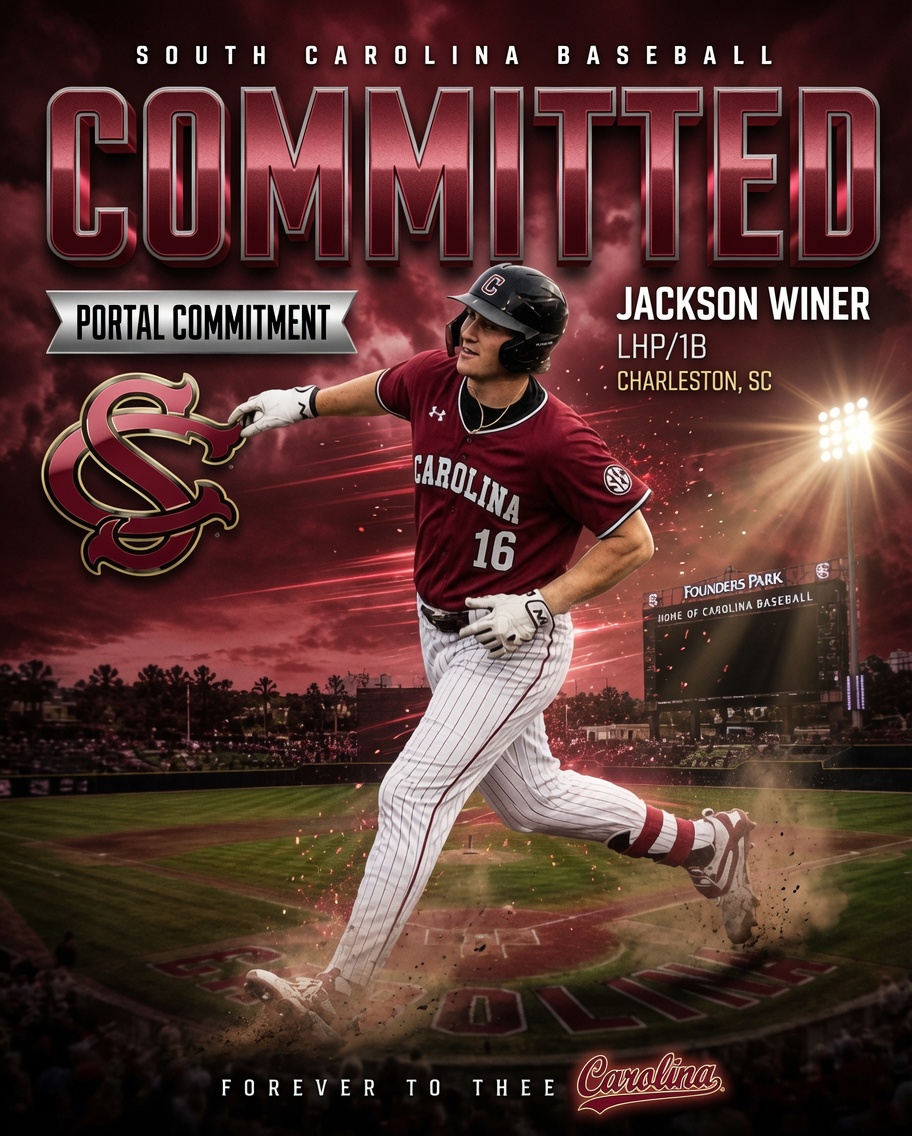
COLUMBIA, S.C. — The Coastal Carolina pipeline to Columbia keeps flowing. On Wednesday, Charleston native Jackson Winer announced his commitment to South Carolina baseball on Instagram, becoming the latest — and perhaps most intriguing — piece of Kevin Schnall’s rapidly assembled portal class. His message was brief but telling:
“Excited for the next chapter #spursup”
Five words. No theatrics. For a player whose full ceiling has yet to be revealed, that quiet confidence may be entirely appropriate. Because what Jackson Winer represents is not a finished product — he is a projection, a bet on upside, and if the tools translate the way his high school evaluations suggested they would, he could end up being the most impactful long-term addition of the entire Schnall era’s opening week.
The Coastal Pipeline: Now Five Deep
Winer’s commitment makes him the fifth Coastal Carolina player to follow Schnall to South Carolina in the span of roughly 24 hours — joining pitchers Hayden Johnson, Colby Richardson, and Daniel Parker, and infielder Walker Mitchell. At this point, the Coastal-to-Columbia pipeline is not a coincidence or a convenience. It is a deliberate, relationship-driven recruiting strategy built on Schnall’s intimate knowledge of his former program’s roster.
With Winer, however, Schnall is not just adding depth or familiarity. He is adding a player with a profile that does not exist anywhere else in this portal class: a true two-way prospect with legitimate power potential on offense and untapped pitching ability that has not yet been deployed at the college level. In an era where two-way players command enormous attention — fueled in large part by the Shohei Ohtani effect at the professional level — landing a player of Winer’s two-way pedigree gives South Carolina a development project with a genuinely unique ceiling.
The Hitter: Raw Power in an Unfinished Package
Let’s start with the offensive profile, because that is where Winer spent the entirety of his freshman season. His 2026 numbers at Coastal Carolina were a study in extreme contrasts — the kind of statistical line that tells you something real is there, even if the full picture is still being assembled.
Winer did not make his collegiate debut until April 10, meaning he played the back half of the season exclusively and did so while clearly still finding his footing. Despite that compressed timeline, he appeared in 27 games with 18 starts, posting a .241 batting average with five home runs, six doubles, 19 RBIs, and a .494 slugging percentage across just 83 at-bats. That slugging figure is the number that demands the most attention. Nearly a half of all his at-bats ended in extra bases or worse for the opposing defense — a rate that reflects genuine raw power and the ability to do real damage when he makes contact.
The early burst was particularly electric. After starting strong with three home runs in his first two starts, he had an up-and-down rest of the year — a perfectly normal trajectory for a freshman who debuted late, was still adjusting to college velocity and secondary stuff, and was navigating a lineup role as primarily a designated hitter behind Colby Thorndyke at first base. The .241 average reflects the inconsistency of early-career development, not a ceiling. The .494 slugging percentage reflects the floor.
His best individual performance — homering twice and driving in three runs at Wake Forest on April 14, and collecting a season-high four RBIs at Georgia Southern on May 3 — showed flashes of what he can do when he is locked in. Those are not fluky numbers. Those are the outputs of a player with legitimate impact potential when his swing decisions and timing converge.
The Pitcher: The Great Unknown
Here is where the Winer projection becomes genuinely fascinating — and where South Carolina’s patience and development philosophy will be tested most directly. Despite being listed as a left-handed pitcher on Coastal Carolina’s roster, Winer did not see any action on the mound during his freshman season. None. He was kept exclusively in the DH role while the Chanticleers leaned on their existing pitching staff.
That means South Carolina is inheriting a player whose pitching ceiling is almost entirely unknown at the college level — known only through the lens of high school evaluations that, it must be said, were extremely encouraging. Coming out of the Class of 2025, Winer was ranked by Perfect Game as the top left-handed pitcher and the fifth-best overall player in the state of South Carolina. In a state that consistently produces high-level college baseball talent, being the consensus No. 1 left-handed arm in your graduating class is not a modest distinction. That ranking reflects velocity, projectability, and the kind of stuff that professional evaluators and college scouts agreed represented a legitimate pitching future.
The question Schnall and pitching coach Matt Williams now face is how and when to begin unwrapping that pitching potential. There is no urgency to rush it — Winer has three full years of eligibility remaining, and his offensive value alone justifies his roster spot. But the long-term upside of a left-handed bat with genuine power at the plate and a legitimate arm on the mound is a combination that, if developed properly, could make Winer one of the most valuable players in the SEC before his career in Columbia is finished.
The MLB Draft implications of that two-way ceiling are also worth noting. If Winer develops into a credible college pitcher alongside his offensive production, his professional stock could rise dramatically — which creates a healthy tension between South Carolina’s desire to develop and showcase him and the very real possibility that his junior year could attract significant draft attention.
The Charleston Connection and High School Pedigree
Like the other South Carolina natives in this portal class — Johnson from Myrtle Beach, Parker from Hartsville, Richardson from Mullins — Winer brings genuine home-state roots to Columbia. He is a Charleston native who played at Bishop England High School on Daniel Island, where he earned All-State honors in both 2024 and 2025 and was named All-Region Player of the Year in back-to-back seasons. That sustained recognition across multiple years of high school competition reflects consistency and competitive dominance, not one-year variance.
His father, Matthew Winer, played baseball at Oglethorpe University — giving Jackson a household steeped in the game and an understanding of what it takes to compete at the collegiate level. That baseball background, combined with the two-way tools that attracted both college and professional interest coming out of high school, paints a picture of a player who has been preparing for this opportunity his entire life.
The Late Start: Context That Matters
One detail from Winer’s freshman season that deserves proper context is the timing of his debut. He did not make his collegiate debut until April 10 — meaning he missed the first six-plus weeks of the season entirely. The exact reason for that delayed start has not been formally disclosed, but the impact on his statistical line is significant. A player who misses the first third of his freshman season and then posts a .494 slugging percentage in 83 at-bats over the remaining stretch is not a player who struggled as a freshman. He is a player who was limited by circumstance and still produced power at an elite rate when given the opportunity.
With a full offseason of preparation and a genuine spring camp behind him, Winer’s sophomore numbers in Columbia should provide a much cleaner read on what he is actually capable of.
What Winer Means for the Schnall Rebuild
In the broader context of this portal class, Jackson Winer fills a specific and important role. Walker Mitchell provides veteran leadership and proven offensive consistency for one final season. Hayden Johnson, Daniel Parker, and Colby Richardson give the pitching staff depth and experience across a multi-year arc. Winer bridges both worlds — a potential offensive weapon in the short term and a two-way developmental project that could pay dividends deep into the rebuild.
For a South Carolina program that has been starved of excitement, energy, and genuine upside for two consecutive losing seasons, a player with Winer’s combination of tools and projection is exactly the kind of addition that re-engages a fan base. He is not a finished product. He is not a safe bet. He is a high-ceiling prospect following a coaching staff he trusts, coming home to a state that claims him, and stepping into a program that — for the first time in a long time — feels like it is building toward something real.
The next chapter, as Winer put it, is just beginning. And based on everything that surrounds this commitment, it has the potential to be a very good one.
About The Author