A Story of Circumstance: Why Gavin Braland’s Departure From South Carolina Was Inevitable
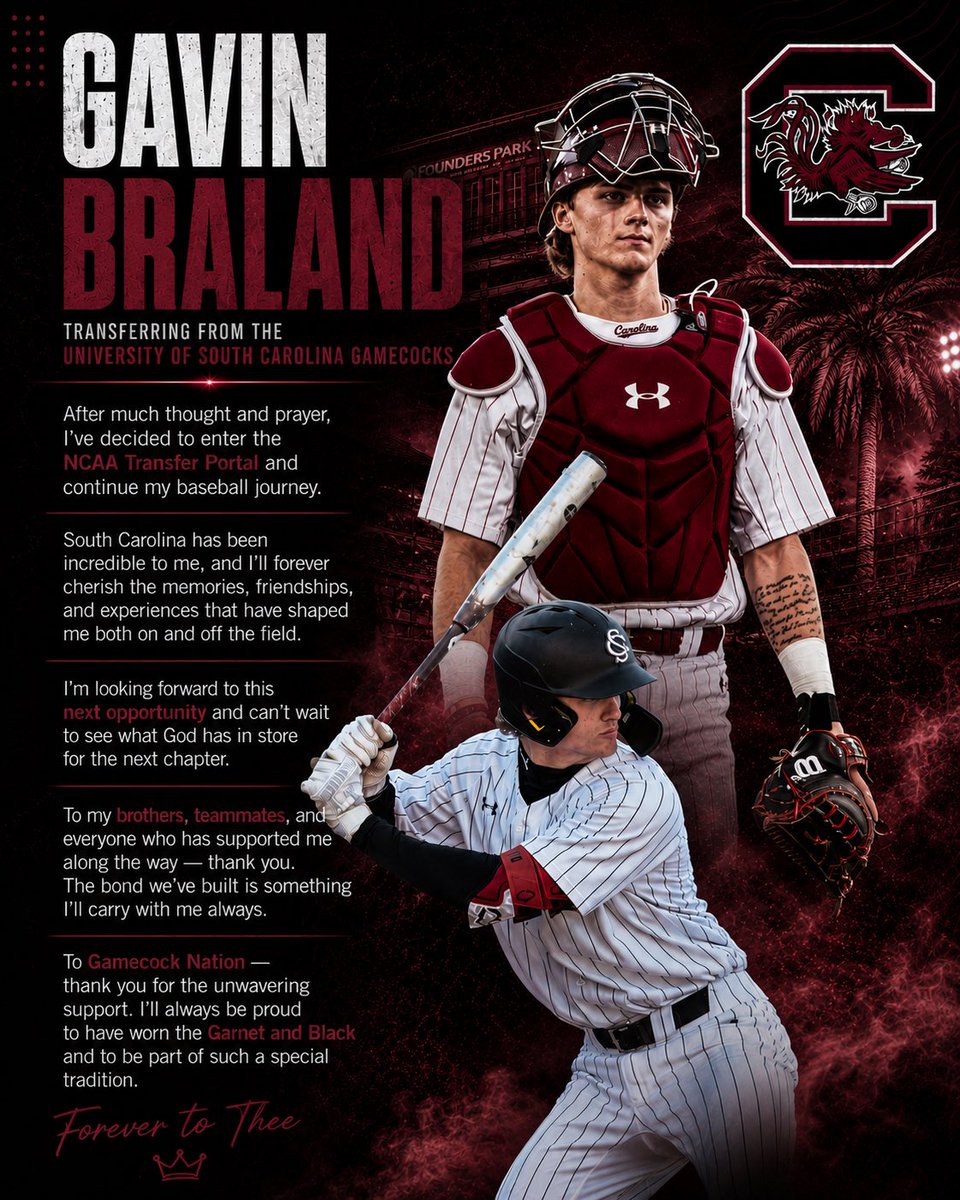
The fifth Gamecock to enter the transfer portal this offseason didn’t leave because of failure. He left because of timing — and because the situation that briefly gave him an opportunity had simply run its course.
South Carolina catcher Gavin Braland announced his departure late Sunday night via social media, bringing to five the number of players who have opted to seek new homes as the program navigates both a coaching search and the uncertainty that accompanies it.
“After much thought and prayer, I’ve decided to enter the NCAA Transfer Portal and continue my college baseball journey,” Braland posted. “South Carolina has been incredible to me, and I’ll forever cherish the memories, friendships, and experiences that have shaped me both on and off the field.”
He closed his statement with the kind of grace that reflects well on both the player and the program he’s leaving. “I’ll always be proud to have worn the Garnet and Black and to be part of such a special tradition,” he said.
With two years of eligibility remaining, Braland now enters a portal window that officially runs June 1 through June 30, looking for a program where he can be the answer rather than the backup plan.
The Circumstances That Defined His Time in Columbia
Braland’s two seasons at South Carolina tell a story that has less to do with his ability and more to do with the hand he was dealt — twice.
His freshman campaign in 2025 began with a defined backup role behind Talmadge LeCroy, one of the program’s most experienced backstops. Then LeCroy went down with a season-ending injury midway through the year, and Braland was suddenly thrust into a starting role he hadn’t been expected to fill. He responded by starting 28 of the 36 games he appeared in — a workload that speaks to the coaching staff’s willingness to trust him in an unplanned situation.
The numbers from that season — a .194 batting average, 10 RBI, and 93 at-bats — aren’t eye-catching, but context is essential. He was a freshman catcher absorbing significant playing time in the SEC after the team’s starter went down. Defensively, he was reliable, posting a .988 fielding percentage and handling a demanding workload behind the plate in one of the most physically taxing conference schedules in college baseball.
Then 2026 arrived — and so did LeCroy.
With his starter healthy and reclaiming virtually every game behind the plate, Braland’s role collapsed entirely. One start in seven appearances. One hit in seven at-bats. A season that, by any honest measure, never really happened for him.
This is the fundamental tension of catching depth on a competitive program. Braland didn’t decline — the opportunity simply disappeared. There is no meaningful development path for a catcher making one start in an entire season, and both the player and the coaching staff almost certainly understood that the current roster configuration left him without a viable future in Columbia.
What He Brings to His Next Program
The market for Braland should be real, and here’s why.
His defensive track record is the foundation. A .988 fielding percentage over two seasons, combined with the experience of handling SEC pitching staffs as a starter under unexpected circumstances, gives his next program something concrete to evaluate. His arm — three caught stealing in 46 attempts — reflects an area where improvement is needed, but the overall defensive package is that of a player who has proven he can handle the position at a high level of competition.
Offensively, the .194 career average at South Carolina needs to be weighed against a more relevant data point: the .339 average he posted for the Purcellville Cannons in the Valley League in summer 2024, with 11 RBI and nine walks in just 20 games. That summer performance, combined with a .302 career average across four years at Georgia Premier Academy, suggests a hitter whose collegiate numbers reflect situation and opportunity as much as pure ability.
He was also the No. 6 ranked catcher and No. 41 overall prospect in the state of Georgia in the Class of 2024 per Perfect Game — a ranking earned before he ever faced SEC pitching. The talent evaluation that brought him to a Power Four program in the first place hasn’t expired.
Five Departures and Counting
Braland’s exit, taken in isolation, is a roster management story. Taken alongside the departures of Patrick Dudley, Alex Valentin, Josh Gunther, and Dawson Harman, it becomes something more significant.
Five players in the span of days, across multiple position groups and class years, is a program sending a signal — not necessarily about South Carolina’s culture or direction, but about the very real consequences of coaching transition uncertainty in the transfer portal era. Players who see a murky path forward no longer wait to find out how things resolve. They act first, while the portal is open and the market is active.
For whoever South Carolina’s next head coach turns out to be, this offseason exodus is simultaneously a problem and an opportunity. The roster is being reshaped in real time, whether by design or by default. The question is whether the right leader can be in place quickly enough to stabilize what remains, identify the portal additions to fill the gaps, and begin rebuilding the kind of roster continuity a program at this level needs to compete.
Gavin Braland did everything asked of him in Columbia, stepped up when circumstances demanded it, and left with his dignity and his reputation intact. His next program will be getting a player whose best baseball almost certainly hasn’t been played yet.
About The Author