Big-Time Praise for Kendal Briles: Already Turning Heads at South Carolina, Briles Earns Major SEC Respect
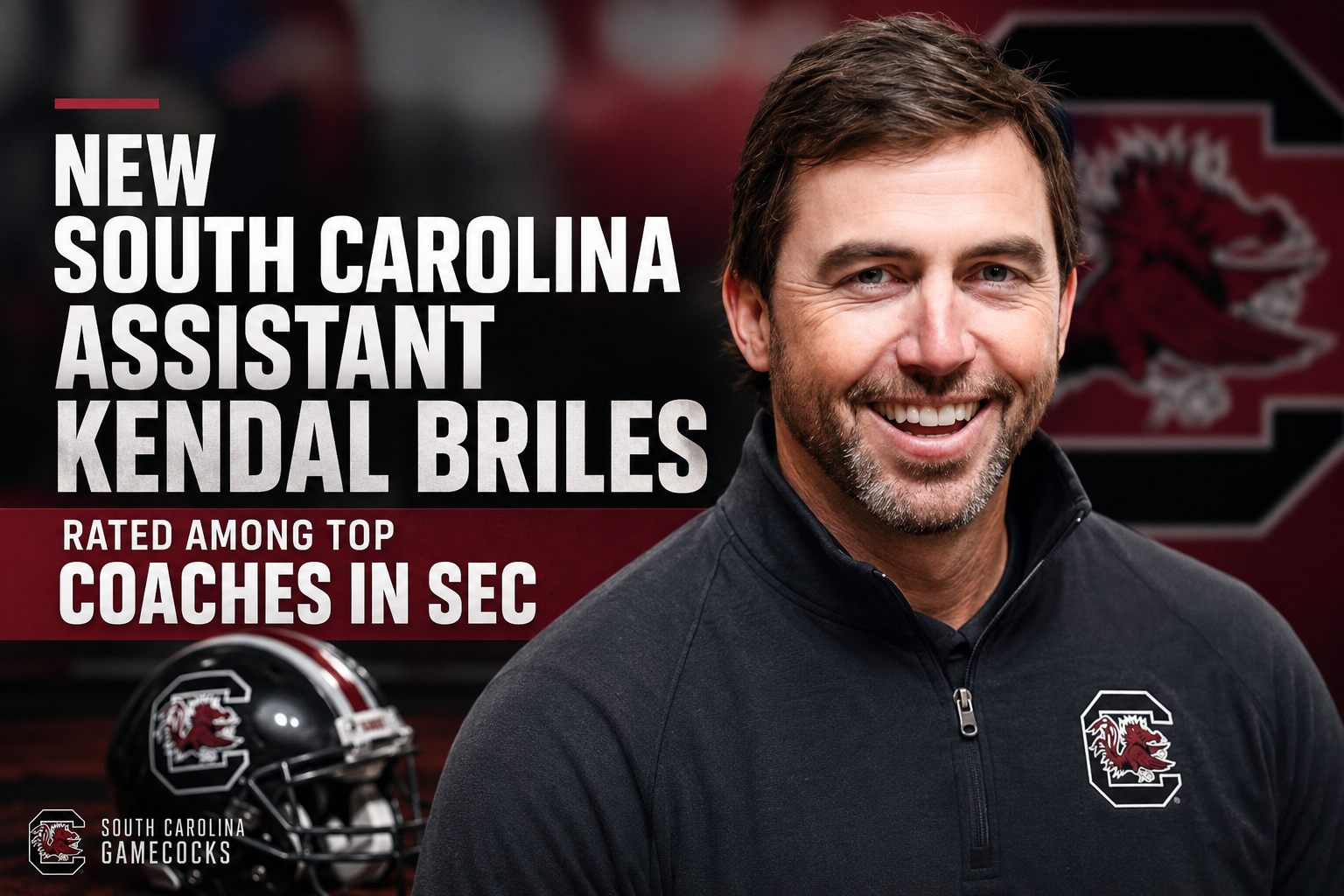
COLUMBIA, S.C. — When Shane Beamer fired offensive coordinator Mike Shula before the 2025 season had even finished, he was not simply making a personnel change. He was making a declaration — that the offensive identity South Carolina had been running was no longer acceptable, and that the program needed a fundamental reimagining of how it scores points. The man Beamer chose to lead that reimagining is Kendal Briles, and the early external evaluations of that hire suggest the Gamecocks may have landed one of the more impactful offensive minds available in this coaching cycle.
According to Matrix Analytical Solutions’ Dave Bartoo — whose metrics are adjusted for talent and ranked on a per-play basis — Briles rates as the SEC’s No. 4 quarterbacks coach. He trails only Tennessee’s Joey Halzle, Georgia’s Mike Bobo, and LSU’s Charlie Weis Jr. in the league, with Auburn’s Joel Gordon rounding out the top five. Perhaps most telling is the margin separating Briles from the third spot: according to Bartoo’s metrics, Briles is less than two one-thousandths of a percentage point below Weis for the third spot. By any honest measure, he belongs in that top tier conversation.
For a South Carolina program that has cycled through offensive coordinators without finding a consistent identity, landing a coach rated in the conference’s top four at his position is not incremental improvement — it is a categorical upgrade.
A Career Built on First-Year Improvements
One of the most compelling elements of Briles’ résumé is its pattern. He brings with him a track record of success, including first-year improvements at almost every stop of his career — a consistency that is exceptionally rare in a profession where coordinators routinely need multiple seasons to implement a system and develop their personnel. The list of stops is extensive: two seasons at Baylor from 2015 to 2016, one year each at Florida Atlantic, Houston, and Florida State from 2017 to 2019, three years at Arkansas from 2020 to 2022, and three years at TCU from 2023 to 2025.
That breadth of experience across programs of varying size, talent level, and conference affiliation is actually a significant asset for South Carolina specifically. Briles has not been sheltered in one system at one program. He has adapted, rebuilt, and produced in multiple environments — and done so with different quarterback profiles, different rosters, and different surrounding talent levels. That versatility is precisely what a mid-tier SEC program needs from its coordinator. South Carolina is not Georgia. It cannot simply plug elite four-star talent into a scheme and let the recruiting rankings do the work. It needs a coordinator who can scheme around limitations and maximize what he has — and Briles’ track record suggests he is exceptionally capable of exactly that.
It is also worth noting the unconventional path that shaped him. A former multi-positional college football player at Texas and Houston, Briles played and coached under his father, Art Briles, at Houston and Baylor respectively, primarily coaching wide receivers during that period. Having played quarterback in high school, he became a full-time quarterbacks coach in 2015 and has been one ever since — bringing a player’s perspective to the position that purely academic coaches simply cannot replicate. He is the most accomplished OC/QBs coach at South Carolina in some time, and the contrast with what preceded him is stark.
The Dual-Threat Dimension: LaNorris Sellers Stands to Benefit Most
Here is where the Briles hire shifts from analytically interesting to genuinely exciting for South Carolina’s fan base. Among the most consistent threads running through Briles’ entire career is his history of developing quarterbacks who can run the football — and the Gamecocks happen to have one of the most dynamic dual-threat quarterbacks in the SEC sitting in their locker room.
The evidence across Briles’ career is overwhelming. At Houston, dual-threat D’Eriq King had nearly 3,700 yards and 50 total touchdowns in just 11 games under Briles — a production rate that remains one of the most staggering single-season outputs by a college quarterback in recent memory. At Arkansas, bigger-bodied dual-threat KJ Jefferson posted more than 6,600 total yards and 60 touchdowns in two seasons with Briles — numbers that made Jefferson one of the most discussed quarterbacks in the SEC during that period.
The connective tissue between King and Jefferson is not physical profile — one was a smaller, quicker option and the other a physically imposing weapon. The connective tissue is Briles, who identified the strengths of each player and built an offense around them rather than forcing his quarterbacks into a rigid schematic box. That coaching philosophy maps extraordinarily well onto LaNorris Sellers, whose athletic ability as a ballcarrier has been evident but, by Beamer’s own implicit acknowledgment in making this hire, insufficiently schemed around.
Briles’ work at Baylor also underscored the importance of the QB run game, coaching offenses that excelled despite two quarterbacks being forced into action — meaning the system produced even in conditions of adversity and roster disruption. That is something that should appeal to Gamecock fans eager to see LaNorris Sellers unleashed as a ballcarrier. It should also appeal to Sellers himself, who now has a coordinator whose entire career demonstrates a genuine commitment to the quarterback as an offensive weapon rather than a game manager.
It is worth noting that at TCU, Briles demonstrated his full-spectrum offensive capability by helping Josh Hoover and the Horned Frogs’ passing game finish in the top 10 nationally in both 2023 and 2024 — even without leaning heavily on the quarterback run game. That adaptability — running the ball with the quarterback when he has a D’Eriq King, maximizing the pass game when he has a Josh Hoover — is exactly what separates elite offensive coordinators from merely competent ones. Briles can coach to the personnel. That is an increasingly rare quality.
The Clements Factor: A Package Deal That Strengthens the Entire Offense
The Briles hire did not arrive in isolation, and that context matters enormously. Briles brought offensive line coach Randy Clements with him to South Carolina from TCU — and the two have now worked together for 12 seasons across Baylor, Houston, Florida State, and TCU. The relationship runs even deeper than their shared coaching history: Clements coached Briles as an assistant at Stephenville High School and at Houston. This is not a coordinator and an offensive line coach who are still building trust and shared vocabulary. These are two coaches who have spent over a decade finishing each other’s sentences.
The quality of that relationship cannot be understated for an offense trying to install a new system in a compressed offseason window. When the offensive coordinator and the offensive line coach are genuinely in sync — when protection schemes, run game concepts, and play-action design are being built from the same foundational understanding — the entire offense operates with a coherence and efficiency that disconnected coaching staffs struggle to replicate.
Bartoo’s external evaluation validated that combination decisively. Clements was Bartoo’s No. 1 offensive line coach in the SEC — not top five, not top three, but first in the entire conference. For a South Carolina program whose offensive line has been a persistent point of frustration in recent seasons, landing the SEC’s top-rated offensive line coach is a development that deserves far more attention than it has received in the broader conversation about this staff overhaul.
Rounding out the new offensive staff is veteran assistant Stan Drayton, who will serve as the team’s associate head coach and running backs coach. Drayton slotted in at No. 4 among running back coaches in Bartoo’s SEC rankings — meaning South Carolina’s offensive staff now includes the conference’s No. 1 offensive line coach, No. 4 quarterbacks coach, and No. 4 running backs coach, all operating within the same coordinated system.
The Bigger Picture: A Staff Built to Win Now
Shane Beamer has faced persistent questions about whether his program can take the next step in the SEC, and the 2025 season — whatever its final record — clearly provided enough internal evidence that a significant offensive reset was necessary. The decision to fire Shula in-season, absorb the short-term disruption, and begin the search for a genuine upgrade reflects a head coach who understood the stakes and acted on them.
The Briles hire, when evaluated honestly and in full context, is the most significant offensive coordinator addition South Carolina has made in years. The external analytics back it up. The career track record backs it up. The specific alignment between Briles’ strengths and South Carolina’s most important offensive asset — LaNorris Sellers — backs it up. And the package that came with Briles, anchored by the SEC’s top-rated offensive line coach and a decade-plus coaching partnership, backs it up.
The 2026 season will be the first real test. If the pattern of first-year improvements that has defined Briles’ career holds in Columbia, South Carolina’s offense could look dramatically different — and dramatically better — than anything Gamecock fans have seen in recent memory.
Beamer needed to get this hire right. By every available measure, he did.
About The Author