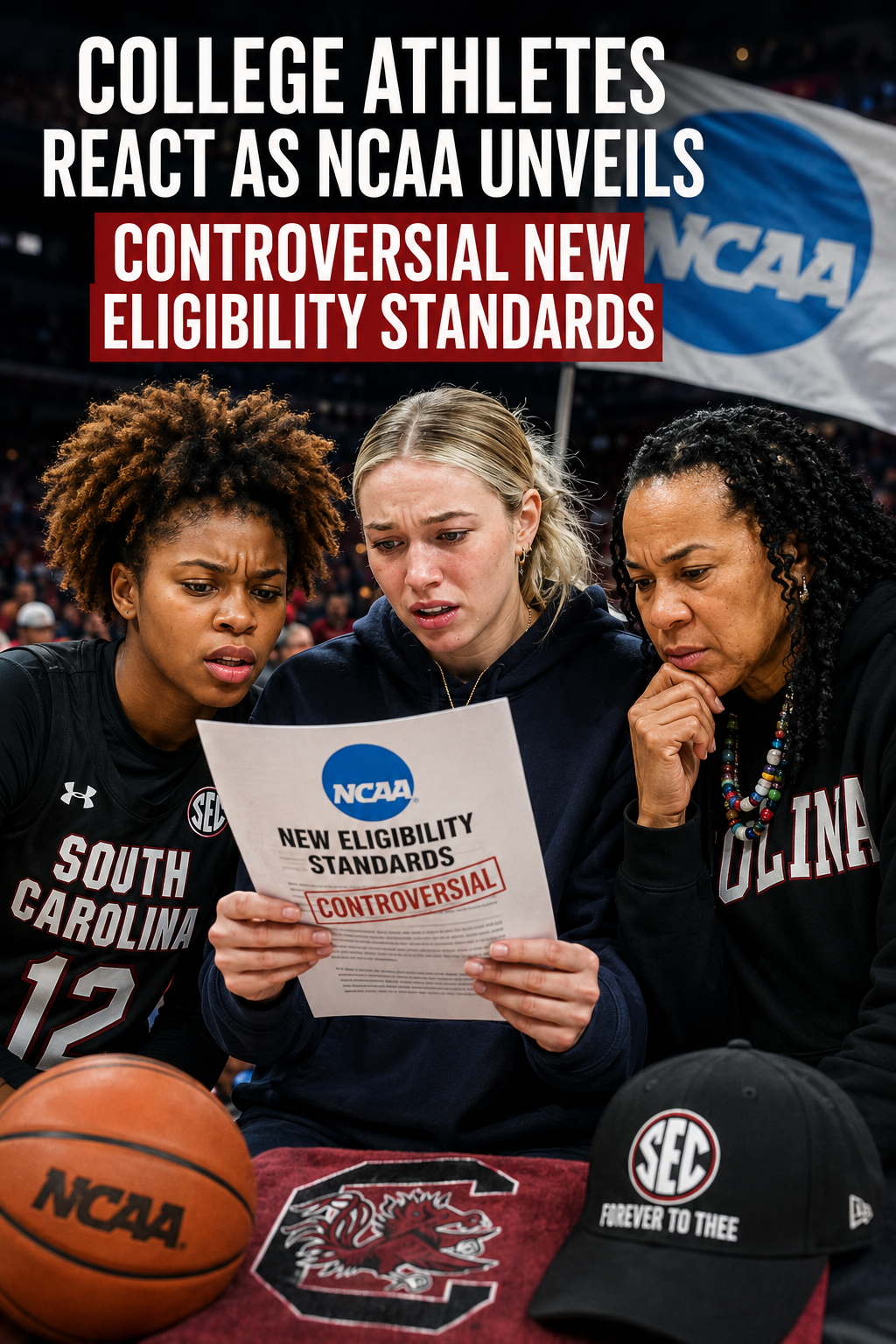
College Athletes React as NCAA Unveils Controversial New Eligibility Standards
College Athletics Will Never Look the Same: The NCAA’s “Five-in-Five” Rule Changes Everything
A unanimous vote by the Division I Cabinet signals the end of an era — and the beginning of a simpler, younger, and fundamentally different version of college sports.
The NCAA has rarely moved with unanimity on anything. On Tuesday, it did — and the ripple effects will reshape college athletics for generations.
The Division I Cabinet voted unanimously to adopt an age-based eligibility model that fundamentally restructures how long student-athletes can compete in collegiate sports. Known as the “five-in-five” rule, the new framework gives athletes five years to play five seasons — a clean, straightforward clock that replaces one of the most complicated, inconsistently applied systems in sports governance.
The vote is complete. The rule change will be officially finalized when the council concludes its meeting on Wednesday, with additional clarifying details to follow at a later date.
What the “Five-in-Five” Rule Actually Means
The core concept is simple by design. Under the new model, a student-athlete’s eligibility clock begins the academic year after either their high school graduation or their 19th birthday — whichever comes later — and runs for exactly five years. Within that window, they have five seasons to use. When the clock runs out, so does their eligibility.
That simplicity is the point. The current system is a labyrinthine collection of written guidelines, subjective judgment calls, waiver processes, and case-by-case determinations that has produced years of inconsistency, controversy, and — particularly in the COVID era — a significant accumulation of older athletes across the collegiate landscape. The “five-in-five” model doesn’t try to patch that system. It replaces it entirely.
What’s Going Away — And Why It Matters
The implications of this shift are sweeping. Under the new framework, several mechanisms that have defined modern college athletics will effectively cease to exist as meaningful tools:
Redshirt years — the practice of sitting out a season to preserve eligibility — lose much of their purpose when a single five-year clock governs everything regardless of whether a player competes.
Medical waivers — historically granted to athletes who suffered season-ending injuries and sought to recover a lost year of eligibility — would no longer be available under most circumstances. An injury that costs a player a season now simply costs them a season.
Academic pauses — years away from competition for academic reasons — would similarly count against the clock rather than being set aside.
Sixth-year extensions and beyond — a byproduct of the COVID eligibility era that allowed unprecedented numbers of older athletes to remain in college sports — would become effectively impossible for future athletes under the new model.
The exceptions carved out from this stricter framework are deliberately narrow: pregnancy, religious mission, and active-duty military service. Outside of those specific circumstances, the clock runs whether a player competes or not.
The Transition: What Happens to Current Athletes
The NCAA has built a transition mechanism that protects athletes who are already in the system under the old rules.
Programs may continue to petition for waiver requests under the existing framework through July 31 of this year — a short but meaningful window for cases already in process. Athletes who have already received approved eligibility for a sixth year or beyond will not lose that eligibility under the new model. After August 1, however, schools and athletic programs will handle scholarship decisions for active players internally, without the NCAA waiver infrastructure that previously governed those situations.
The message is clear: honor existing commitments, but begin the transition now.
The Broader Impact: A Younger, More Unified College Sports Landscape
Step back from the rulebook details, and the larger picture comes into focus.
The “five-in-five” model accomplishes two things simultaneously that the old system never could.
First, it unifies eligibility rules across all sports under a single standard — something that has never existed in NCAA athletics. Previously, different sports operated under meaningfully different eligibility frameworks, creating confusion and inequity across programs and institutions. That inconsistency ends under this model.
Second, it systematically reduces the presence of significantly older athletes in college competition — a dynamic that accelerated dramatically after the NCAA granted blanket COVID eligibility extensions in 2020 and 2021. Those decisions, reasonable at the time, had the unintended consequence of creating multi-year eligibility backlogs that filtered through the system for years afterward, producing rosters with athletes in their mid-to-late twenties competing alongside 18-year-old freshmen. The “five-in-five” clock, starting from a defined age-based baseline, closes that gap structurally rather than relying on case-by-case management.
What It Means for Programs and Recruiting
For coaches and athletic programs, the practical implications are significant. Roster planning becomes more predictable — a five-year clock with almost no exceptions means programs can project athlete availability with much greater confidence than the current system allows. The waiver ecosystem that required dedicated compliance staff hours and generated endless uncertainty largely disappears.
For recruiting, the model creates a cleaner standard for evaluating where a prospect sits in their eligibility window. The ambiguity around how many years a transfer has remaining, whether a medical waiver will be granted, or whether a redshirt year will be approved — all of that complexity collapses into a single, transparent clock.
For athletes, the trade-off is real. The safety nets that once existed — the ability to bank a year through a redshirt, recover a season lost to injury through a medical waiver, or pause competition for academic reasons without burning eligibility — are largely gone. The five-year window is the window. How it gets used is the decision.
The Bottom Line
Tuesday’s unanimous vote isn’t a minor procedural adjustment. It is a structural overhaul of how college athletics governs one of its most fundamental questions — who is eligible to compete, and for how long.
The “five-in-five” model is cleaner, simpler, and more predictable than anything that has come before it. It will produce a younger college sports landscape, a more unified eligibility standard across sports, and a system that demands far less interpretive judgment from administrators and compliance offices.
The finalization comes Wednesday. The details and clarifications will follow. But the direction is set — and college athletics will not look the same on the other side of it.
The rule change will be officially finalized when the Division I Council completes its meeting on Wednesday. Programs may still petition for waivers under the old system through July 31.
About The Author