
Gritty, Flawed and Ultimately Victorious: South Carolina Softball Opens NCAA Tournament With 7-4 Win Over Cal State Fullerton
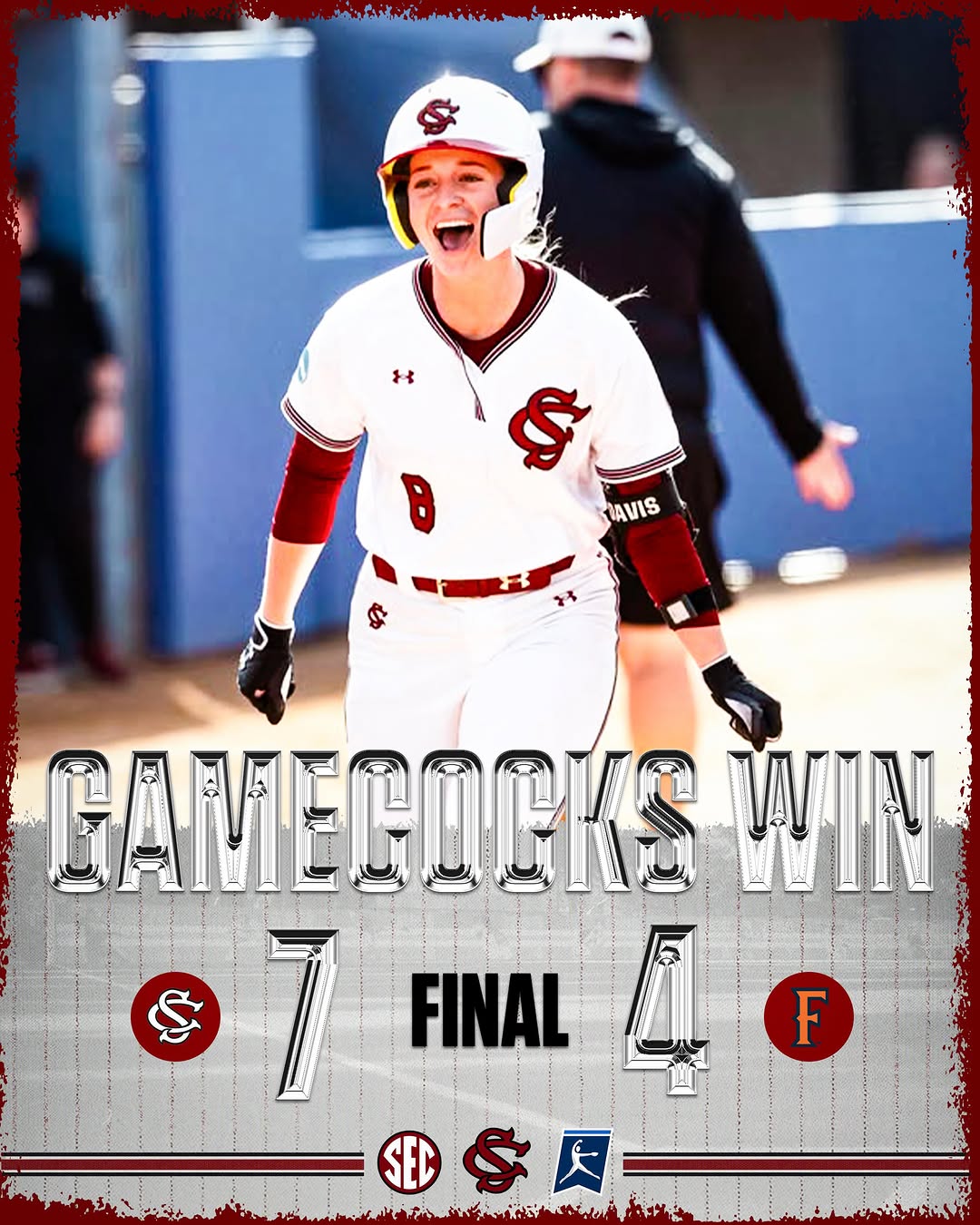
LOS ANGELES — It was not pretty. It was not clean. It was, at various points, maddening. But when Quincee Lilio sent a ball to right field in the bottom of the sixth inning with two on and two out, all the errors, the missed opportunities, the questionable baserunning, and the high pitch counts faded into the background. South Carolina softball opened its NCAA Tournament run with a 7-4 victory over Cal State Fullerton on Friday night — a win that required the Gamecocks to be at their worst and their best within the span of the same game.
That tension, between a team capable of clutch production and a team capable of self-inflicted damage, is the defining analytical story of South Carolina’s evening — and arguably of its season heading into the postseason.
The Lilio Moment: What South Carolina’s Coach Had Been Asking For
Context matters when evaluating Quincee Lilio’s sixth-inning explosion. Head coach Ashley Chastain Woodard had entered the tournament with a specific, stated concern about her offense: the need to find that tide-turning hit, the ability to deliver when the situation demanded production rather than just contact. It is a distinction that separates good offensive teams from great ones — the capacity to convert pressure moments into runs rather than leaving them as near-misses on the stat sheet.
South Carolina had spent much of Friday night demonstrating exactly the problem Chastain Woodard had identified. The Gamecocks made contact consistently, but contact without results is ultimately noise. Multiple baserunning errors cost them momentum at critical junctures. A player was thrown out taking third on a night when every base extended felt like a gamble the Gamecocks couldn’t consistently win.
Then came the sixth. Tied at four, runners on base, two outs — precisely the situation where the Gamecocks’ offensive identity was being tested. Lilio answered emphatically, driving a ball to right that gave South Carolina a 7-4 lead and turned what had been a frustrating evening into a winning one. Less than ten minutes earlier, the Gamecocks had trailed 4-3. Two swings changed the game’s entire complexion.
“I always dreamed of this moment,” Lilio said postgame. “It was just awesome to see my mom in the stands, my brother… I have nine people here.”
The personal weight behind that quote gives the moment additional resonance. Lilio is a California native playing in a Los Angeles regional — essentially a home game in the most meaningful sense — and she delivered the decisive blow with family watching from the stands. Tournament moments are made of exactly this kind of convergence, and South Carolina benefited fully from it.
Friedel’s Mixed Night: Promising Stuff, Unsustainable Pitch Economy
Emma Friedel entered this regional as one of the program’s most reliable arms, a junior transfer who had been building real momentum heading into the postseason. She showed why in the opening frame, sitting down the Titans 1-2-3 with two strikeouts. On pure stuff, she looked the part.
The problem was immediately visible to anyone watching the pitch count: 20 pitches to retire three batters is not sustainable across a full game. Long at-bats are a product of pitcher-hitter battles, and while winning those battles through strikeouts is the ideal outcome, doing so at the cost of 20 pitches per inning creates a compression problem that forces coaching decisions earlier than any staff wants to make them.
The second inning revealed the consequence. After recording her third strikeout of the game, a grounded single put two runners on for Fullerton. A wild throw moved both runners into scoring position, and despite working a favorable 0-2 count, Friedel gave up a gap double that scored both. The 40-win Titans entered the evening 27-1 when scoring first on the season — a statistic that underlines exactly how dangerous it was to let them get on the board early.
The fourth inning brought the end of Friedel’s evening. With one runner down and two more on base, Chastain Woodard went to the bullpen, bringing on Jori Heard. Friedel’s final line — 62 pitches across 3.1 innings, three hits, two earned runs — reflects a pitcher whose performance was adequate but whose efficiency was not, and in tournament softball where every out from your starter matters, the pitch-per-inning number is a concern that will need monitoring as the weekend progresses.
Heard’s entry did not immediately stabilize the situation. Lopez, undeterred by the pitching change, delivered a third RBI to pull Fullerton level at three — a reminder that inherited runners are among the most psychologically demanding situations a reliever can face in high-stakes competition.
South Carolina’s Defensive Lapses: Three Errors Cannot Become a Pattern
The most concerning analytical thread running through South Carolina’s performance Friday night was not the pitching workload or the baserunning mistakes — it was the defense. Three errors in a single game at the NCAA Tournament level is not a recipe for a long postseason run, and against a Fullerton team that finished the regular season with a .975 fielding percentage, the contrast in defensive reliability was stark.
The most damaging error came in the fifth, when a misplay put Big West Player of the Year Sarah Perez on third. A single off the wall scored her. That sequence — a fielding mistake leading directly to a Fullerton run — is precisely the kind of unearned damage that can unravel games against disciplined programs. Fullerton had the roster to capitalize on those mistakes, and they did.
The baserunning errors compounded the problem by neutralizing offensive production before it could convert into runs. A questionable decision to take third led to an out during what should have been a momentum-building frame. Multiple similar decisions across the evening turned potential rallies into innings-enders, and in the fifth — with the bases loaded and two outs, needing just one hit to re-tie the game — Arianna Rodi chased strike three to end the threat.
These are the kinds of moments Chastain Woodard was referencing when she discussed needing that tide-turning hit. When you are self-inflicting damage on the bases and in the field, the margin for offensive error shrinks dramatically. South Carolina’s ability to survive a three-error, multiple-baserunning-mistake performance against a 40-win opponent says something about the talent in their lineup — but surviving such a performance against UCLA, waiting in the next round, would require a far more disciplined brand of execution.
The Offensive Arc: From Dormant to Decisive
South Carolina’s offense told a story of gradual awakening on Friday night, building through adversity toward the decisive moments in the game’s final innings.
The Gamecocks went down 1-2-3 in the first despite making what looked like solid contact — a frustrating but not unusual pattern for a lineup facing a quality arm for the first time. The second inning produced the first significant breakthrough: Tate Davis sent a home run to left that tied the game at two, providing the Gamecocks with their first genuine offensive momentum. That home run should have given South Carolina a lead, given what preceded it, but the baserunning mistake that followed erased the potential advantage and kept the game level.
Back-to-back two-out doubles in the third gave South Carolina its first lead of the night — a sequence that speaks well of the lineup’s ability to string together production with two outs, a skill that separates genuinely dangerous offenses from ones that are merely active. Two-out hitting in college softball is a mark of mental resilience, and for a stretch, the Gamecocks demonstrated exactly that.
The momentum didn’t hold through the fourth and fifth, as Fullerton regained and then extended their lead. But when the sixth arrived and the lineup came back around, Lilio was ready. The three-run swing that turned a 4-3 deficit into a 7-4 lead did not just win a game — it answered the specific competitive question that Chastain Woodard had posed entering the tournament.
South Carolina’s defense finally delivered in the closing frames, sitting down three of the next four batters to seal the result and send the Gamecocks into Saturday’s schedule.
What Chastain Woodard Said — and What It Means Going Forward
In her postgame assessment, Chastain Woodard kept it appropriately measured. This was not a statement victory, and she did not frame it as one:
“Really gritty win as a team. Just found a way to win. Hope it propels us through the rest of the weekend.”
That framing — gritty, found a way — is the honest characterization of what happened Friday night. South Carolina did not outclass Fullerton. They made enough mistakes to have lost this game comfortably against a more ruthless finisher. What they did do was survive their own lapses, find the clutch swing they needed at the exact moment they needed it, and hold on in the final frames when composure was required.
Whether it propels them through the weekend depends on which version of this team shows up next. On Saturday at 5 p.m. EDT, they will face the winner of regional host UCLA against Cal Baptist — almost certainly a Bruins team that entered this regional as the No. 8 national seed with a 47-8 record and one of the most loaded offensive lineups in the country. Against Jordan Woolery, Megan Grant and the Bruins’ collective firepower, three errors and multiple baserunning mistakes will not be survivable.
Friday’s win bought South Carolina another day in Los Angeles. Saturday’s opponent will demand they earn it with significantly more discipline. The talent is clearly present — Lilio proved that. The consistency, across all phases, is what the Gamecocks still need to find.
About The Author