It’s Bree Hall a Third Chance — and Amber Cox’s Explanation Reveals Exactly Why Indiana Is Built Different
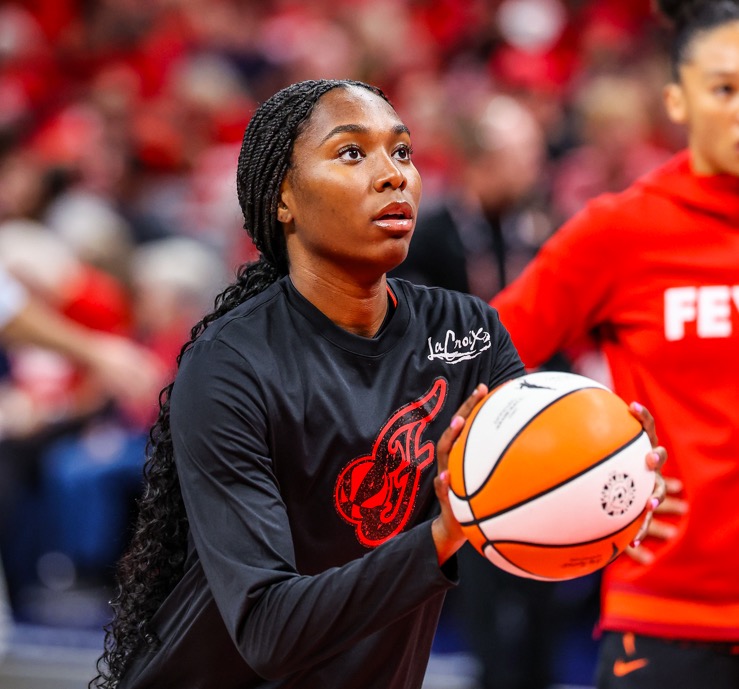
The Indiana Fever have filled their final roster spot, and the choice they made says more about how this organization evaluates talent than any transaction since Caitlin Clark’s arrival changed the franchise’s trajectory entirely.
Bree Hall is back — for the third time.
The 6-foot-1 guard and 2025 second-round pick has signed with Indiana on a developmental contract, completing a 14-player roster that now includes two players on the league’s newly established developmental deal structure. She joins Justine Pissott, the Fever’s 2026 second-round pick who was signed to the first developmental contract before training camp even began.
The decision to bring Hall back — again — is not a transaction born of desperation or a lack of alternatives. It is a deliberate organizational choice rooted in genuine conviction about a player whose development arc has apparently impressed the people watching it most closely.
Understanding the New Developmental Contract Structure
Before analyzing the Hall signing specifically, the structural context of what these contracts actually mean deserves proper examination — because this is genuinely new territory for the WNBA.
Under the league’s updated roster rules for 2026, teams are permitted to carry 14 players, with the final two spots designated specifically for developmental contracts. These deals operate under a framework designed to keep promising young players inside professional environments without the financial and roster-count complications that previously forced teams to make difficult cuts purely on numbers rather than merit.
The financial structure is notably player-friendly: developmental contracts do not count against the salary cap, and players receive housing as part of the arrangement. On the activity side, developmental players may be activated for up to 12 games per season while maintaining full-time status with the organization — attending practices, participating in team activities, and existing within the competitive environment on a daily basis.
For perspective on why this matters: Bree Hall was in Indiana’s training camp last season, demonstrated enough to generate genuine organizational interest, and was waived purely because the numbers didn’t work. She then re-signed on a hardship deal when injuries created a roster opening, appeared in one regular-season game, and played in four playoff games. Under the old structure, that was the ceiling of what the Fever could offer a player at her developmental stage. Under the new structure, Hall gets a legitimate professional home — training, coaching, game experience, and the kind of sustained organizational support that accelerates development in ways that a series of hardship contracts never could.
Why Hall, Specifically?
The Fever had one developmental spot remaining after signing Pissott. That means Indiana’s front office evaluated its options and chose Hall — a player they have now brought back three times — over every other available alternative. That consistency of organizational conviction is not accidental, and Fever general manager Amber Cox explained the reasoning with notable specificity on “Fever Weekly.”
“We’ve loved her progress. She really had a great plan going into the offseason, just in terms of what she wanted to do to get better. Really took our feedback to heart. And I think you’ve seen a lot of that progress take shape in the offseason.”
That quote is worth unpacking carefully. Cox is not describing a player who showed up to camp and looked impressive in drills. She is describing a player who received coaching feedback, internalized it, built an intentional offseason plan around addressing specific developmental gaps, and then executed that plan visibly enough that the organization noticed. That process — feedback, accountability, self-directed improvement — is how professional athletes develop. It is also precisely what separates players who stick from players who cycle through on hardship deals indefinitely.
The physical profile that drives the organizational enthusiasm is also clearly articulated by Cox:
“A long, long wing that can really get out and defend. That’s been her calling card since her time at South Carolina. And she can knock down a three. She wasn’t called upon to do it a ton in South Carolina, but again, she has made that a real focal point to really build on her game and continue to evolve to be a great pro. So we’re excited to add her to that last spot.”
The language here — “long, long wing” — speaks directly to the physical archetype that modern basketball at every level values above almost everything else. Switchable, lengthy defenders who can guard multiple positions and contest shots without fouling are among the most coveted players in the sport. Hall’s calling card is the hardest thing to teach. You cannot coach 6-foot-1 wingspan and the defensive instincts that her South Carolina training under Dawn Staley helped develop. The three-point shooting is the teachable layer on top of an unteachable physical foundation — and Cox’s framing of it as Hall’s intentional offseason focus suggests the work has already begun producing results.
There is also a medical footnote worth acknowledging. Cox confirmed that Hall has been managing plantar fasciitis, an injury that affected the timing of her return to the organization:
“She’s been dealing with a little bit of plantar fasciitis that she needed to get some treatment and ultimately is managing. So it was a bit of a timing thing to get her back in here a little bit later than training camp. But we’re just excited about her potential.”
Plantar fasciitis is a chronic, often stubborn condition that can linger for weeks or months and flare under the accumulated stress of daily professional training. The Fever’s willingness to absorb that medical complexity rather than simply choosing a healthier alternative speaks to the depth of their belief in Hall’s upside. When a front office accounts for a health issue and signs the player anyway, it is a statement of conviction that a line on a transaction wire cannot fully communicate.
The South Carolina Pipeline: Asset or Narrative?
Hall’s signing raises the roster count of former South Carolina Gamecocks on the Indiana Fever to four. She joins Aliyah Boston, Raven Johnson, and Ty Harris — a concentration of players from a single program that has inevitably generated commentary, some of it conspiratorial, across social media.
The analytical reality is more straightforward than the narrative suggests. Dawn Staley’s South Carolina program has, over the past decade, produced professional-caliber talent at a rate that few college programs in women’s basketball can match. Boston is an established WNBA contributor. Johnson has carved out a legitimate role. Harris brings veteran experience. Hall arrives with a defensive profile directly traceable to Staley’s system, which has historically prioritized exactly the kind of switchable, communicative defense that translates well to the professional level.
The Fever are not collecting South Carolina players as a philosophical statement — they are accessing a talent pipeline that consistently produces the defensive infrastructure and professional-readiness markers their roster construction values. The fact that four players from the same program ended up on the same professional roster is less a conspiracy than it is a reflection of which college programs are currently doing the best job of preparing players for what comes next.
What Hall Adds to an Already Deep Guard Room
The legitimate roster construction question surrounding Hall’s return is not whether she deserves a developmental contract — the organizational conviction on that point is clearly established. It is what she can actually contribute within an Indiana rotation that is already heavily loaded at guard.
Caitlin Clark and Kelsey Mitchell lead the starting lineup. Raven Johnson, Ty Harris, and Shatori Walker-Kimbrough provide backcourt depth off the bench. Sophie Cunningham and Lexie Hull occupy the wing positions that most naturally complement Hall’s profile.
With 12 games of activation available under the developmental contract structure, Chastain Woodard will need to identify specific situations where Hall’s particular skill set — elite defensive length, developing three-point shooting, switchability — provides something the existing rotation cannot replicate. That is a narrower brief than most prospects would prefer, but it is also an honest description of what the developmental contract framework is designed for: a full-time professional environment that prepares a young player for a more expansive role in the future, rather than demanding she fill one immediately.
The Fever play in Los Angeles on Wednesday before returning home to Gainbridge Fieldhouse for a demanding four-games-in-eight-days stretch against Washington, Seattle, Portland, and Golden State. Whether Hall is activated for any of those contests will depend on both her plantar fasciitis management and where Chastain Woodard sees an opportunity to give her meaningful minutes.
The longer arc, though, is what matters most. Hall is 22 years old, physically gifted, organizationally committed, and being developed inside one of the WNBA’s highest-profile programs with daily access to Clark, Boston, and a coaching staff that has demonstrated it knows how to build players.
“We’re just excited about her potential,” Cox said.
In the WNBA’s new developmental contract era, that excitement — backed by structure, housing, practice time, and real game opportunities — means something it simply did not before. Bree Hall has been given every reason to make this third chance her last one. Whether she seizes it fully is the story still being written.
About The Author