No Suspension, No Demotion: The Texas Trooper Who Chest-Bumped South Carolina Players Faces Minimal Consequences
What began as a viral moment on a college football sideline has now reached its quiet, unsatisfying conclusion — and for the South Carolina Gamecocks, the outcome raises serious questions about accountability, authority, and the treatment of Black athletes in high-stakes public settings.
The Incident: A Touchdown, a Tunnel, and a Confrontation
Last November, wide receiver Nyckoles Harbor delivered one of the most electrifying plays of South Carolina’s season — an 80-yard touchdown reception that sent the Gamecocks into halftime with momentum against Texas A&M. As Harbor’s stride carried him into the tunnel, a handful of teammates followed to celebrate the score. What should have been a moment of pure joy quickly became something far more troubling.
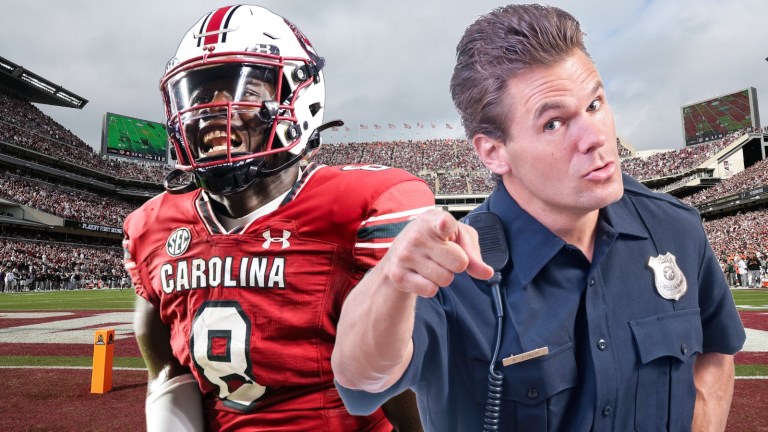
In footage that spread rapidly across social media, a Texas state trooper was seen making deliberate physical contact — a chest bump — with a pair of South Carolina players near the tunnel entrance, followed by a verbal confrontation directed at the group. The clip drew immediate national attention and widespread criticism, with many viewers questioning why a law enforcement officer would initiate physical contact with college athletes in what was, at its core, a postgame celebration.
In the aftermath, Harbor’s teammate Oscar Adaway escalated the matter publicly, threatening legal action and demanding a formal public apology. The trooper was relieved of his gameday duties in College Station. Harbor, for his part, stayed largely silent — until now.
Harbor Breaks His Silence
Speaking at his youth football camp last week, Harbor was asked about the incident by a young attendee — a moment that clearly caught even him off guard. His response was candid and telling.
“He just told us to get out (of the tunnel),” Harbor said. “Not in a polite way, though. He got in a couple curse words, but he told us to get out.”
The comment strips away any remaining ambiguity about the nature of the exchange. This was not a misunderstanding or a case of crossed signals — it was an aggressive, profanity-laced confrontation initiated by a law enforcement officer toward a group of college athletes who had just scored a touchdown. The physical contact, combined with the tone Harbor described, paints a picture of an interaction that had no business happening at a football game.
The Investigation: Six Months, and a Slap on the Wrist
The Texas Department of Public Safety’s Office of Inspector General launched a formal investigation into the incident in the immediate aftermath. Six months later, the results are in — and they are underwhelming.
According to reporting by Chapel Fowler of The State, the trooper was not suspended, demoted, or fired. He received what officials vaguely described as “corrective action.” A Texas DPS spokeswoman confirmed that an internal investigation “revealed that the trooper acted in a manner contrary to the department’s rules, regulations, and expectations of its employees” — an acknowledgment of wrongdoing that, remarkably, produced no formal disciplinary consequence.
The lack of transparency surrounding the specifics is shielded, conveniently, by Texas law. Under the state’s open records statutes, investigation documents related to officer misconduct are only subject to public disclosure if the outcome involves a discharge, suspension, or demotion. Since none of those occurred, the full record remains sealed.
“The responsive records consist of an investigation that did not result in disciplinary action, as defined above, being taken against a commissioned officer,” a representative for the Texas DPS Office of General Counsel said via email. “Therefore, the requested records are confidential, and our office is prohibited by law from releasing this information.”
In other words: the department admits the trooper was wrong, but the punishment — whatever it was — falls below the legal threshold that would require the public to know what actually happened.
The Bigger Picture
The trooper, who earns just under $100,000 annually and has served with the Texas Department of Public Safety for more than two decades, will continue in his role with the department going forward. There is no firing. No suspension on record. No public apology — something Adaway had specifically demanded.
For South Carolina’s players, this outcome is a frustrating but familiar one. They were physically confronted by a law enforcement officer in a public setting, the incident was captured on video for the entire country to see, a formal investigation confirmed the officer acted improperly — and yet the practical consequences are minimal, hidden behind legal definitions designed to limit accountability.
Harbor’s willingness to finally speak on it, even in the casual setting of a youth camp, suggests the moment still resonates. It should. What happened in that tunnel was wrong, the investigation confirmed it was wrong, and the response from the institution responsible has been to quietly absorb it and move on. South Carolina’s players — and the public — deserved better than that.
About The Author