
“The Problems Haven’t Changed in 25 Years”: Dawn Staley Breaks Down the Real Foundation of Her Coaching Philosophy
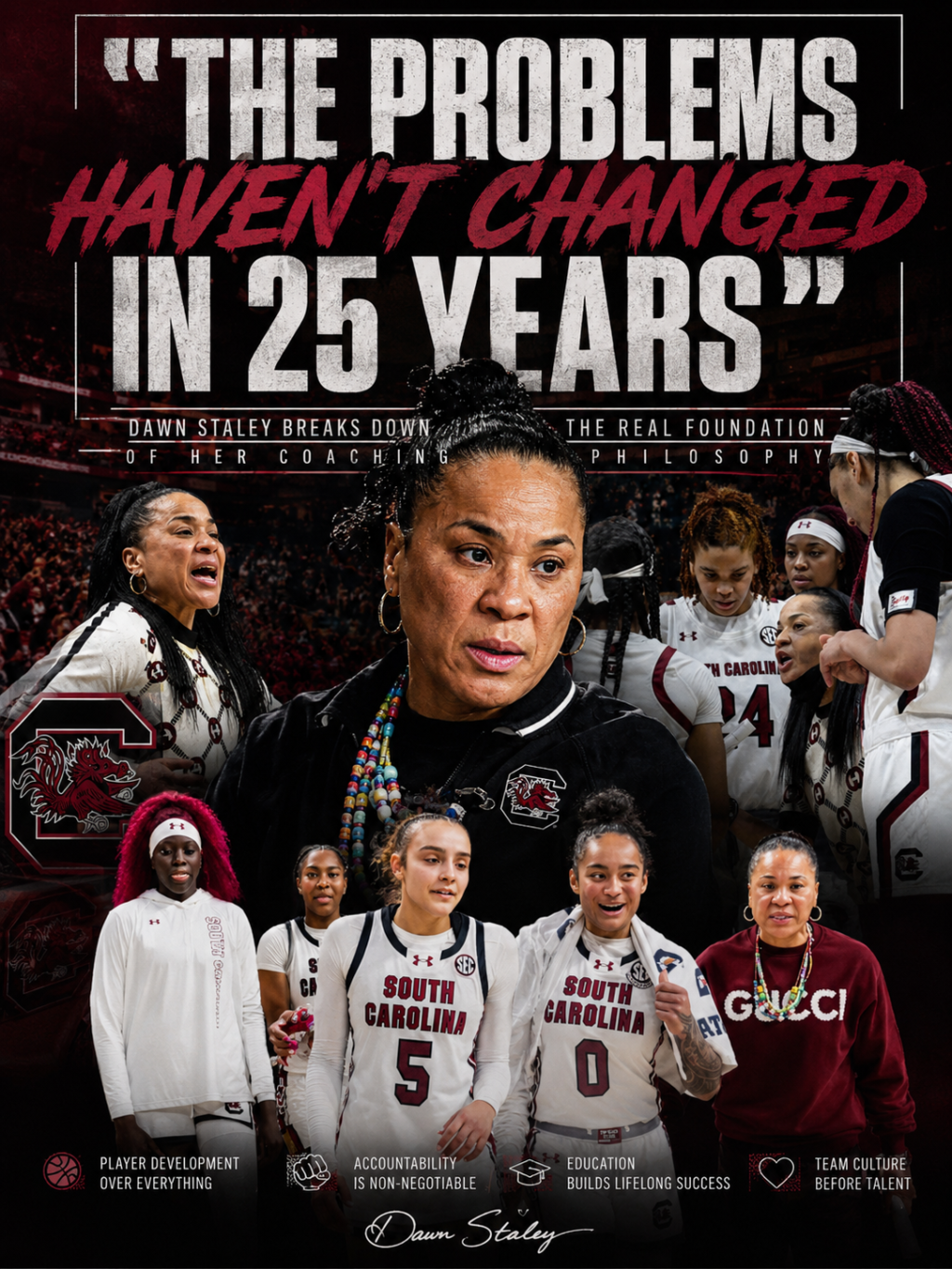
Hall of Fame coach Dawn Staley sat down with the IMO Podcast for a wide-ranging conversation about coaching philosophy, player development, and what it actually takes to build a winning program at the college level — and the conversation offered a rare, direct look at the framework behind one of the most successful runs in college basketball history.
No rulebook, just character
The most striking element of the discussion is what Staley says she doesn’t rely on: a traditional rulebook. Standards like punctuality and communication aren’t treated as policy in her program — they’re treated as character traits, qualities she believes players need to develop as people, not just as athletes. That’s a meaningfully different approach than the standard college sports model, where tardiness or poor communication typically triggers a disciplinary consequence rather than a deeper conversation.
In Staley’s view, when a player shows up late or fails to speak up, the issue runs deeper than a policy violation. That framing reflects an approach she’s articulated in other settings as well — describing her focus as being on “people principles” rather than “basketball principles,” on the belief that once that foundation is in place, the basketball itself becomes the easier part to teach.
Consistency across 25 years
Perhaps the most telling insight from the conversation is Staley’s observation about time. With 25 years of coaching behind her, she notes that the problems she sees have stayed largely the same throughout her career. That’s a significant admission from someone who has coached across multiple eras of the sport — through vastly different rosters, conference landscapes, and now the transfer portal and NIL era. If the underlying issues she’s managing haven’t fundamentally changed, it suggests the challenges of coaching are less about the shifting mechanics of college athletics and more about the constants of human development: maturity, accountability, and communication.
That consistency is precisely why her focus has always centered on who her players are becoming rather than what they are or aren’t allowed to do. It’s a subtle but important distinction — a rules-based approach manages behavior in the moment, while a character-based approach is meant to produce people who don’t need the rule in the first place.
Why this matters beyond basketball
This philosophy helps explain patterns that have shown up publicly throughout Staley’s tenure — including her program’s recent handling of guard Maddy McDaniel’s decision to step away from the team for her mental health. A coaching approach built around meeting players as people first, rather than enforcing rigid policy, tracks closely with Staley’s public response in that situation, where she emphasized giving players “the space and the grace to work through” personal struggles. Heard alongside this IMO Podcast conversation, that response looks less like an isolated statement and more like a direct application of the same philosophy she’s describing here: developing people first, and letting the basketball follow.
For a program that has produced multiple national championships, Olympic-level talent, and a steady pipeline of professional players, Staley’s comments offer a useful reminder that her results may have as much to do with her approach to human development as with her approach to X’s and O’s.
About The Author