Dawn Staley Is Hunting Two Generational Point Guards — A Look at All The 2027 Prospects Class
The 2026 recruiting cycle is barely in the rearview mirror, and Dawn Staley is already operating at full speed on the 2027 class. The roster she’s building for next season has the national media calling it a “super team” — but what comes after that determines whether South Carolina sustains a dynasty or simply peaks. Here is where things actually stand with the top 30 prospects in the 2027 class, and what it all means for the Gamecocks.
The Point Guard Hunt: Two Elite Options, One Clear Priority
The most urgent and fascinating storyline of South Carolina’s 2027 recruiting pursuit centers on the point guard position — and the class happens to offer two of the best options the sport has seen in years at that spot.
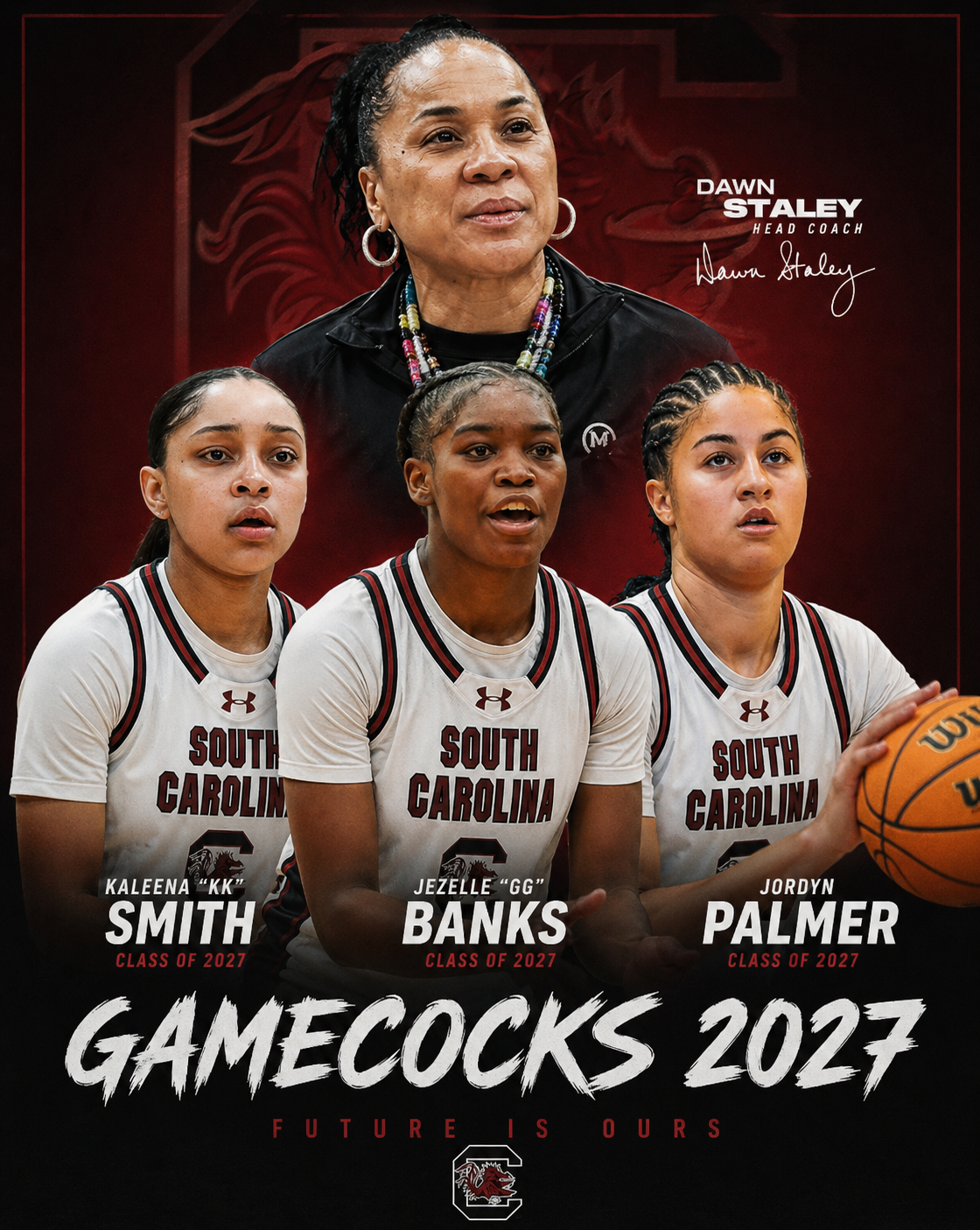
Kaleena “KK” Smith (5-5, Point Guard) is the crown jewel of the entire 2027 class, full stop. The term “generational talent” gets applied loosely in recruiting circles, but Smith genuinely earns it — by definition, there can only be one true generational talent per cycle, and she is it. South Carolina has extended an offer and expressed serious interest, but Smith is wisely keeping all options on the table. The financial dimension of this recruitment cannot be ignored. Smith will command top NIL dollar, and programs across the country will have to make a hard internal calculation about how she fits into their budget before they can compete for her signature. For Staley, who has built a pipeline to the WNBA that few coaches can rival, the pitch writes itself — but landing Smith means winning a financial arms race as much as a basketball argument.
Jezelle “GG” Banks (5-9, Point Guard) may ultimately be the more attainable — and in some ways more appealing — target. South Carolina has been invested in Banks since long before she became a top-five nationally ranked prospect, which speaks to Staley’s staff identifying her ceiling before the broader recruiting world caught up. Banks could become the direct beneficiary of the financial complication surrounding Smith; if programs decide the cost of Smith isn’t justifiable, the attention pivots immediately to a player who is an elite prospect in her own right. Critically, there’s a school of thought within the Gamecocks’ program that they may like Banks just as much as Smith — or more. That’s a telling signal about how seriously Columbia views her as a fit for their system, not merely as a consolation option.
The point guard need is real. Maddy McDaniel holds down the position on the current roster, but securing the long-term future of that position with a Smith or Banks level talent would be transformational.
The Wing Market: Too Much Talent, Not Enough Spots
South Carolina doesn’t desperately need wing help — they already have Jerzy Robinson arriving in the 2026 class and Agot Makeer returning. But the 2027 class is so loaded at the wing position that the Gamecocks are keeping multiple conversations alive, even knowing they’ll realistically only pull the trigger on one.
Ivanna Wilson-Manyacka (6-1, Wing) fits the South Carolina mold almost perfectly — physical, defensive-minded, and built for the demands of SEC competition. Staley’s program is very interested, and she checks every box the coaching staff typically prioritizes in perimeter players. She remains uncommitted and open.
Jordyn Palmer (6-1, Wing) has flown slightly under the radar compared to Wilson-Manyacka, but represents equally tantalizing upside. Where Wilson-Manyacka leans defensive, Palmer skews more offensively versatile — a complement rather than a replica. Most importantly, Palmer has concrete plans to visit South Carolina this summer, which moves this from background interest to an active, developing recruitment that deserves close attention.
Micah Ojo (6-0, Wing) rounds out the wing trio of interest. She may be slightly less polished than the two names above her in the rankings, but that developmental upside is precisely what makes her intriguing for a program that has consistently turned raw talent into WNBA draft picks. South Carolina holds an offer and maintains genuine interest. Realistically, the Gamecocks are likely to prioritize one of these three rather than pursuing all of them simultaneously — but the depth of options at this position gives Staley flexibility that most programs would envy.
Kie’Aundria Acree (6-1, Wing) is a longer-term relationship that predates most of these newer conversations — South Carolina first offered Acree when she was in middle school, which speaks to how early the program identified her potential. Interest remains on both sides, though Acree appears to currently sit behind the higher-ranked wing targets in the Gamecocks’ priority order.
The Post Problem: The Hardest Puzzle in the Class
This is where the 2027 recruiting landscape gets genuinely challenging for South Carolina, and where roster construction may require creative thinking rather than straightforward high school recruitment.
Caroline Bradley (6-5, Post) was the class’s top post prospect and the only plug-and-play option at the position. She committed to LSU in early April, ending what was described as one of the least surprising recruitments in recent memory. With Bradley off the board, the post landscape in 2027 becomes considerably murkier for every program that needed her — including South Carolina.
What remains at the post position in the 2027 class is largely developmental. Jayla Forbes (6-7) has the height that generates rankings attention, but her current production hasn’t caught up to her measurements — her ranking reflects potential more than proof. Harper Dunn (6-6) is similarly more projection than production, with a complicated high school career that adds uncertainty to an already uncertain evaluation. Khalia Hartwell (6-4) is the top 2027 prospect from within South Carolina’s home state, but opinions on her ceiling vary dramatically, and neither side appears to have generated meaningful mutual interest.
The honest assessment: if South Carolina is going to address the post position for the 2027 roster, it is more likely to happen through the transfer portal than through the high school class. Staley just demonstrated this offseason that she can identify and land elite portal talent — Jordan Lee being the prime example — and there’s no reason to believe that skill expires between cycles.
The Players Who Aren’t in the Picture (Yet)
Several highly-ranked prospects have already effectively closed the door on South Carolina, either by releasing top-five or top-ten lists that omit the Gamecocks or by committing elsewhere. Haylen Ayers left South Carolina off her top five in October. Nation Williams released a top ten in February without including the Gamecocks. Eve Long did the same in December. Miciah Fusilier committed to Baylor.
These aren’t necessarily failures of recruiting — they’re the natural result of a program that is selective enough to only pursue players who fit a specific profile. Staley doesn’t cast the widest net; she casts the most precise one.
Sydney Savoury (5-11, Guard) presents an interesting subplot. With her mother serving as an assistant athletics director at Michigan and her brother playing football at Michigan State, the family ties to the Midwest are significant — but not necessarily determinative. South Carolina holds an offer and the interest is mutual. Whether Savoury is willing to leave home for the chance to compete at the highest level of women’s college basketball is the central question her recruitment ultimately hinges on.
Sydney Mobley (6-2, Forward) included South Carolina in a top-12 list she released in October, keeping the door open. Active momentum has been limited since then, but the offer is on the table and the relationship exists.
The Bottom Line
South Carolina’s 2027 recruiting map is clear in its priorities and honest about its challenges. The Gamecocks are all-in on landing one of the two elite point guards — Smith or Banks — and will pursue at least one impact wing from a deep pool of talented options. The post position is a genuine problem that the high school class may not solve, making the transfer portal the most likely solution.
What this class ultimately reveals is that sustaining a dynasty requires a different kind of discipline than building one. Staley isn’t chasing numbers or padding the rankings. She’s building another precision instrument — and the 2027 class, wherever it lands, will be constructed with the same intentionality that has produced six consecutive Final Fours and counting.
About The Author