How does Justine Loubens Fits the new Predicted Roster Rotation?
When Justine Loubens committed to South Carolina earlier this week, the headlines celebrated the addition with the predictable warmth of a program accustomed to landing talented players from every corner of the globe. What those headlines largely failed to examine is the far more complicated and analytically revealing story buried beneath the surface of this commitment — a story about roster mathematics, positional battles, freshman uncertainty, and the ruthless competitive hierarchy that Dawn Staley’s program demands of every single player who puts on the garnet and black.
Loubens doesn’t just join a roster. She joins a pressure cooker. And not everyone currently in it is going to survive the heat.
The Numbers Game: 14 Players, Limited Minutes, and Zero Guarantees
With Loubens’ commitment, South Carolina now has 14 players signed for next season — a number that immediately raises the stakes for every individual fighting for playing time in one of the nation’s most unforgiving rotation systems. Ashlyn Watkins is notably excluded from these projections entirely, as her expected May return introduces a variable too significant and too uncertain to incorporate cleanly into any honest rotation analysis.
Fourteen players. Dawn Staley’s rotations historically run eight to ten deep on a generous night. Do the math. The margin for error is essentially nonexistent, and Loubens’ arrival — while additive at the program level — is subtractive for at least one player already in the building.
The Backcourt: McDaniel’s Throne Is Secure — But The Wings Are A Battlefield
The projected starting backcourt of Maddy McDaniel at point guard, with Tessa Johnson, Jordan Lee, and Agot Makeer rotating through the guard spots, carries an immediate and significant implication that the arrival of Loubens only sharpens: Dawn Staley went through an entire recruiting cycle without adding a transfer point guard to push McDaniel. That is not an accident. That is a message.
“South Carolina did not add a transfer point guard to compete with McDaniel. That tells me that Dawn Staley is confident that McDaniel is ready to start.”
In Staley’s program, that level of institutional confidence is not given — it is earned. McDaniel is the uncontested floor general, and the roster construction validates that completely.
Below McDaniel, however, the picture becomes considerably messier. Johnson, Lee, and Makeer are projected to absorb the bulk of backcourt minutes — but the analytical nuance here deserves attention. Both Johnson and Makeer logged stretches at backup point guard last season in limited capacities. This season, that responsibility expands whether they are fully prepared for it or not, because Lee’s profile as a non-primary ball-handler makes it structurally necessary for Johnson and Makeer to shoulder more on-ball duties when she is on the floor.
“Johnson and Makeer played backup point guard last season in short spurts, but they will have to play more this season. Lee has never been a primary ball-handler, and bringing her off the bench makes it easier for Johnson and Makeer to slide on-ball.”
This is where Jerzy Robinson enters the conversation — and where the arrival of Loubens delivers its most immediate and uncomfortable consequence. Robinson, the 17-year-old Nike signee who generated enormous buzz with her Final Four appearance alongside her future teammates, arrives with the physical profile of someone who should be difficult to keep off the floor.
“It’s hard not to give Robinson a bigger role. She is a physical scorer who can defend and rebound.”
And yet, the projection suggests Loubens arrives and immediately takes the depth wing spot that Robinson might otherwise have occupied. Robinson may be the third option at both guard spots — a significant demotion from the level of hype surrounding her commitment. For a player of Robinson’s commercial profile and recruiting stature, opening her college career as a fringe rotation piece represents the first real test of whether the South Carolina culture machine can humble even its most celebrated arrivals.
The Loubens analysis itself carries its own asterisks. The French freshman is projected as a wing — bigger and more defensively oriented than a traditional guard, but not physically equipped to handle primary ball-handling responsibilities at this level. “She is definitely a perimeter player, but she doesn’t seem to be enough of a ball-handler to play guard.” That is a polite way of saying Loubens arrives with a defined ceiling in terms of positional versatility, and her value will be almost entirely determined by whether her defensive profile and perimeter game translate immediately to the college level or require the kind of developmental patience that Staley’s rotation rarely affords freshmen.
The most analytically precarious situation in the entire backcourt belongs to Ayla McDowell. The sophomore finds herself in the most uncomfortable roster position of anyone currently in the building — squeezed from above by established veterans and potentially from below by a freshman in Loubens who fits the wing profile more naturally. “Right now, I’m not sure where Ayla McDowell fits, unless Loubens is more of a project than expected.” That single sentence should be read as the quiet alarm bell it is. When the rotation analyst cannot identify where a returning player fits, the player herself should be deeply uncomfortable. McDowell’s sophomore season may function less as a development opportunity and more as an audition for her place in the program’s future.
And Kaeli Wynn? Despite arriving with the shooting pedigree and basketball bloodlines that made her one of the class’s most intriguing additions, the projection is blunt: “Wynn will probably get a de facto redshirt season.” After multiple knee injuries — including a dislocated kneecap that ended her senior high school season — Wynn arriving in Columbia with no definitive recovery timeline and limited to stationary drills essentially removes her from meaningful rotation consideration before the season begins. Her year is likely to be one of rehabilitation, cultural assimilation, and preparation for what she hopes becomes a fully healthy 2027-28 campaign.
The Frontcourt: The All-American Duo Commands the Top — But Depth Is Raw and Injury-Dependent
If the backcourt is a battlefield, the frontcourt is a construction site — filled with talent at various stages of development, multiple injury question marks, and a freshness to the overall group that makes projections inherently fragile.
The starting frontcourt of Chloe Kitts and Joyce Edwards is projected through the cleanest possible analytical lens: “Using the ‘don’t overthink it’ theory, Kitts is slotted with Joyce Edwards as the starters. After all, they are the Gamecocks’ only two former All-Americans.”
That logic is as sound as it is straightforward. Experience and pedigree earn starting positions in Staley’s system until someone competes them away. Kitts and Joyce Edwards are the established standard, and everyone else in the frontcourt is — to varying degrees — working to close the gap.
Joyce Edwards presents the most interesting analytical duality in the frontcourt. She demonstrated the ability to play the post in small-ball configurations — specifically against TCU and UConn — but her limitations against physically dominant big players remain a documented vulnerability. “Against bigger teams, she struggles. That’s where summer workouts will come into play.” The honest subtext of that assessment is that Joyce Edwards heads into next season with a known and exploitable weakness, and the summer will either address it or confirm it. Teams that watched film from last season already have their game plans drawn up.
Alicia Tournebize represents perhaps the most fascinating developmental case on the entire roster. The 6-foot-7 sophomore arrived last season without the strength to consistently defend post players — a critical deficiency for a player of her size and positional profile. A full summer inside South Carolina’s elite strength and conditioning program could be genuinely transformational. “After a summer in South Carolina’s strength and conditioning program, that could change.” If Kitts is not fully recovered from her torn ACL at the season’s outset, Tournebize steps into the starting five — and the entire frontcourt reconfigures accordingly, with Kitts absorbing a reserve role similar to the one Joyce Edwards played as a freshman.
That contingency plan reveals something important about how thin the frontcourt’s margin for error actually is. The starting unit’s integrity is directly dependent on Kitts’ physical recovery — a variable that no amount of recruiting depth can fully insure against.
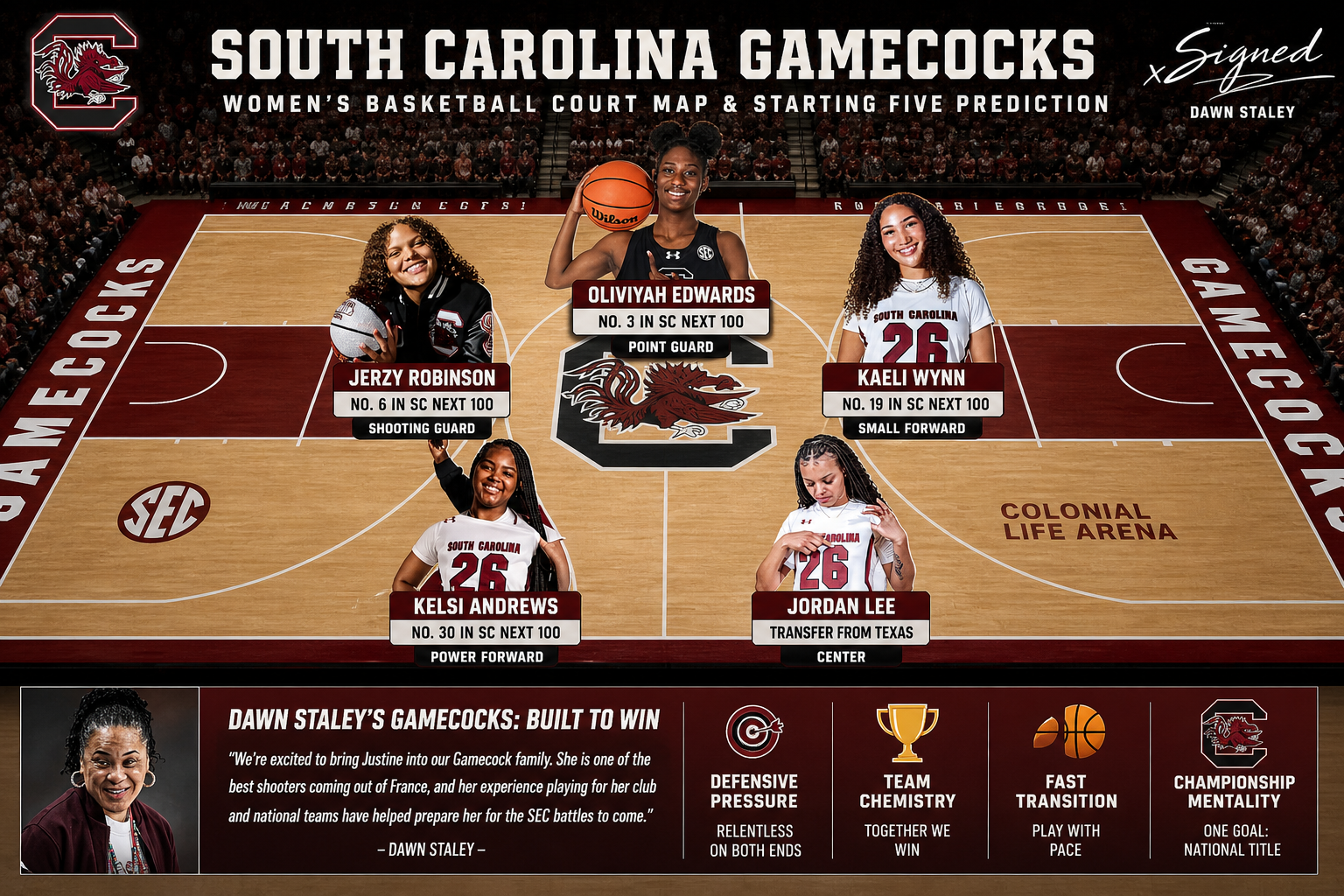
Kelsi Andrews arrives carrying the shooting range and post footwork that her high school coach described in glowing terms — “she can shoot from 15 feet, she can shoot the 3 from NBA range. Other teams can’t extend their defense and can’t sag off of her” — but she too brings a significant medical asterisk. Two previous ACL tears and an October 2025 meniscus surgery have her self-reporting at “about 75 percent” heading into enrollment. A post player with genuine three-point range arriving at three-quarters capacity is simultaneously one of the roster’s most exciting long-term propositions and one of its most immediately concerning realities.
Oliviyah Edwards may be the most intriguing name on the entire roster for reasons that exist almost entirely in the future tense. “The best athlete on the team and has the biggest upside” is an extraordinary statement about a player on a roster this talented. But the qualifier that follows it is equally significant: “her game is pretty raw, and Robinson is probably more college-ready.” Extraordinary upside and raw game in the same sentence is the definition of a player whose impact in year one will be managed carefully, and whose true moment likely comes in 2027-28 when the developmental investment begins to pay dividends.
The Bigger Picture: A Roster Built For the Long Game, Not Just Next Season
What the Loubens commitment ultimately crystallizes is this: Dawn Staley is not merely constructing a team for 2026-27. She is assembling the infrastructure for the next two to three years of Gamecock dominance — accepting the developmental friction and injury uncertainty of the present in exchange for the depth and talent concentration that makes South Carolina a perennial championship threat.
The backcourt has veterans who can lead and freshmen who need time. The frontcourt has All-Americans who can anchor and raw athletes who need development. There are injury question marks at virtually every level of the rotation. And there is a French freshman who just walked into one of the most competitive women’s basketball programs on earth and immediately began reshuffling the depth chart of players who have been there longer.
Dawn Staley has navigated precisely this kind of roster complexity before. She has turned it into championships before. The 14-player signed class is not chaos — it is controlled ambition, executed by a coach who understands exactly where this roster is going even when the rest of us are still trying to figure out where everyone fits.
The Gamecocks are not ready yet. They are getting there. And in Columbia, that has always been enough. 🐓
About The Author