The 9th-Seeded USA Squad Nobody Believed In Just Won The FIBA 3×3 Women’s Series In Chengdu — And The Starting Five Has Deep South Carolina DNA Running Through Its Veins
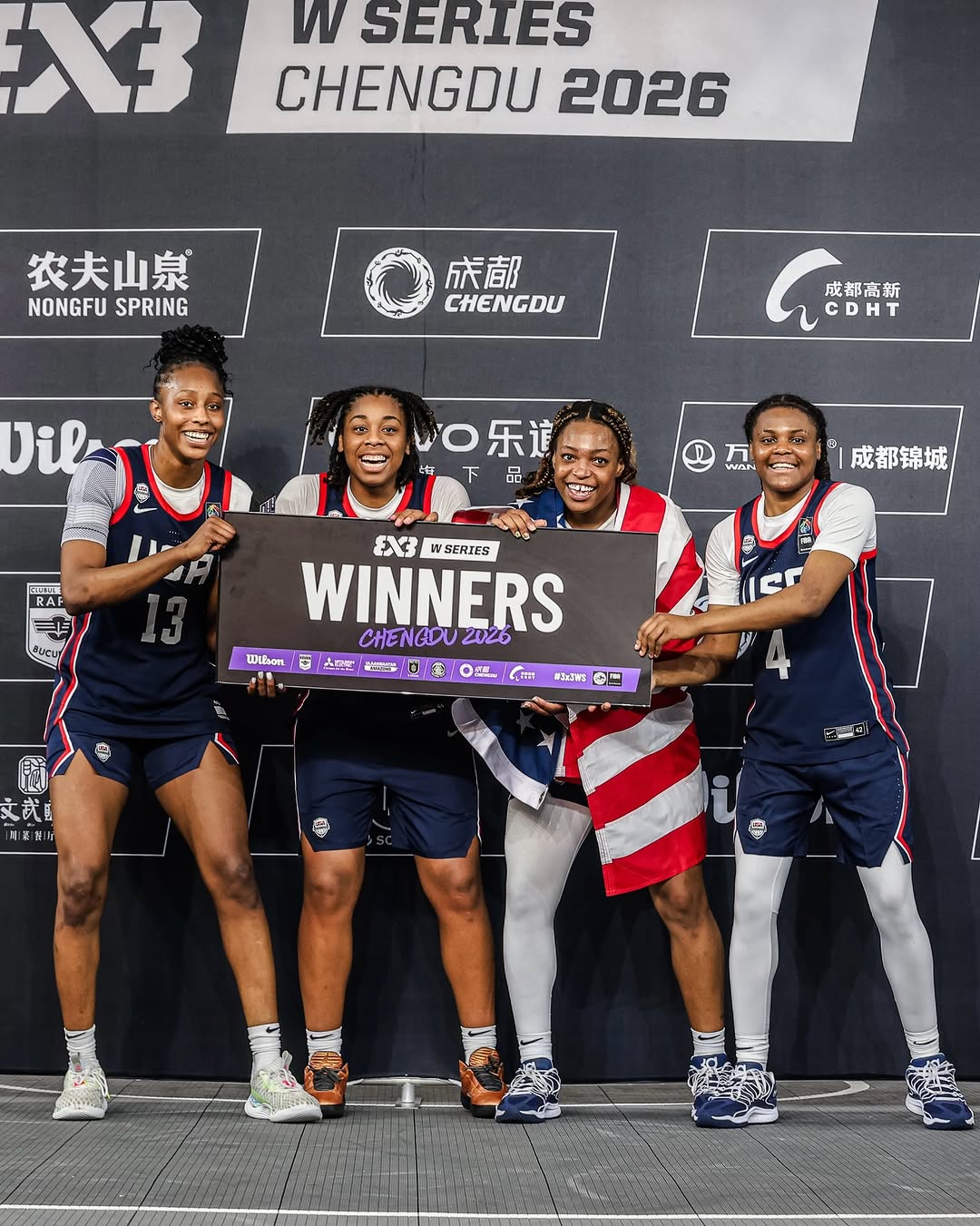
Nobody gave them a realistic shot. Seeded ninth in a 16-team field that included the dominant Ulaanbaatar Amazons, the disciplined Dutch side Amsterdam, and a battle-tested Australian squad riding momentum from the FIBA 3×3 Asia Cup title, Team USA arrived at the iconic Jiaozi Music Square in Chengdu, China, as an afterthought in the tournament conversation.
They left as champions.
USA Basketball opened the 2026 FIBA 3×3 Women’s Series campaign with a four-player roster of young standouts featuring Joyce Edwards, MiLaysia Fulwiley, Mikaylah Williams, and Sahara Williams — and on the half-court stage where the first team to 21 points wins and every possession carries championship-level weight, these four young women were absolutely unplayable.
The Roster: A College Basketball Who’s Who
Before dissecting what happened in Chengdu, it is essential to understand what USA Basketball assembled and why this particular quartet carried championship pedigree before a single 12-second shot clock expired.
Joyce Edwards is the anchor — and the statistical case for her dominance is overwhelming. As a sophomore, Edwards averaged 19.2 points, 6.8 rebounds, 2.4 assists, and 1.8 steals. She set South Carolina’s single-season scoring record with 768 total points and was named first team All-SEC and second team AP All-American. She is the kind of player who simply does not have an off switch — and in the relentless, sprint-format environment of 3×3 basketball, that quality is exponentially more valuable. She has also won three gold medals in 5-on-5 basketball — the 2023 U19 World Cup, the 2024 U18 AmeriCup, and the 2025 AmeriCup. On3 Winning is not a habit for Joyce Edwards. It is a lifestyle.
MiLaysia Fulwiley arrived in Chengdu as perhaps the most decorated 3×3 performer on the roster. Chaos went on to win the entire 3X Nationals tournament, and Fulwiley was named the tournament’s MVP. Her instincts in the half-court setting — the tight spaces, the one-on-one isolation battles, the clutch shot-making — are tailor-made for the compressed brutality of 3×3 competition. At USA Basketball’s national championship, she delivered a game-winning layup against her former South Carolina teammates to secure the title. In Chengdu, she brought that same killer composure to the world stage.
Edwards and Fulwiley were part of USA Basketball’s 3×3 Nations League team last summer. They went 14-2 at the tournament in Punta Arenas, Chile, and won the tournament title. The chemistry between these two former Gamecock teammates is not theoretical — it has been tested, refined, and proven at the international level before Chengdu’s lights ever came on.
Mikaylah Williams of LSU rounds out the perimeter alongside Fulwiley, bringing First Team All-SEC credentials and a scoring arsenal that extends to deep range. Sahara Williams of Oklahoma adds the size, rebounding tenacity, and physicality that complete a roster without an obvious weakness anywhere on the half-court.
The Tournament: Underdogs Who Refused The Label
The United States entered the tournament seeded ninth in the 16-team field — a ranking that placed them firmly in the underdog category behind the Mongolian powerhouses, European heavyweights, and the imposing Australian contingent. The 2025 edition in Chengdu saw Netherlands take home the title, showcasing elite execution and composure on the big stage. Defending champion energy from the Dutch, combined with a field described as deeper and hungrier than ever, made the path for USA Basketball seem decidedly steep.
A total of 16 teams competed in Chengdu, featuring a mix of powerhouse nations, rising programs and local contenders. The 3×3 competitions are played on a half court with a 10-minute clock and a 12-second shot clock — the first team to 21 points or the team in the lead at the end of regulation is the winner. In this format, there is nowhere to hide. No second-half adjustments. No foul to give. Every player must be locked in every second — and USA Basketball’s quartet proved themselves worthy of every moment.
What This Championship Actually Means
Analytically, this result is bigger than a single tournament trophy. It is a statement about the rising commercial and competitive infrastructure of American women’s basketball on the international 3×3 stage — and it carries a deeply specific South Carolina thread running straight through its center.
Edwards is Dawn Staley’s current junior-year cornerstone, the record-breaking scorer who has turned the Gamecocks into appointment television. Fulwiley was a Staley-built product who redefined what a freshman could be in Columbia before transferring to LSU. The presence of both on the same international roster — competing under the same flag, chasing the same championship — proves that the culture Staley constructed in Columbia does not evaporate when players leave. It travels with them.
This group is young, explosively talented, and has now experienced winning at the highest level of the format together. The FIBA 3×3 Women’s Series then moves to Manila on May 7-8 and Shanghai on May 16-17 as early momentum builds in Asia. Manila and Shanghai are next. The rest of the field has been officially warned.
Team USA didn’t come to Chengdu to participate. They came to own it. 🇺🇸🏀
About The Author